
Fiberglass outperforms aluminum in raw tensile strength, while aluminum leads in stiffness. That single distinction shapes nearly every practical decision in window frame selection. Pultruded fiberglass profiles reach tensile strengths of 600–2,000 MPa, compared to 100–400 MPa for 6061-T6 aluminum extrusions. Aluminum, however, carries an elastic modulus of 69–72 GPa versus fiberglass’s 20–40 GPa, making it considerably stiffer under load.
At a glance: key material metrics
- Tensile strength: Fiberglass 600–2,000 MPa vs. aluminum 100–400 MPa
- Elastic modulus (stiffness): Aluminum 69–72 GPa vs. fiberglass 20–40 GPa
- Density: Fiberglass 1.8–2.1 g/cm³ vs. aluminum 2.70 g/cm³
- Thermal conductivity: Fiberglass 0.3–0.5 W/m·K vs. aluminum 167 W/m·K (source)
- Corrosion resistance: Fiberglass is corrosion-immune; aluminum requires protective coatings in many environments
The core trade-off: Aluminum’s stiffness enables slimmer, more architecturally refined profiles. Fiberglass’s tensile strength and near-zero thermal conductivity make it the more durable, energy-efficient choice in demanding climates.
Both materials are genuinely strong. The right choice depends on structural priorities, climate, budget, and design intent — all of which the sections below address in detail.
Table of Contents
- How aluminum and fiberglass frames compare on core material properties
- What makes aluminum frames a strong choice — and where they fall short
- Where fiberglass frames deliver a clear performance advantage
- How climate zone affects which frame material performs better
- Installation, maintenance, and expected lifespan
- Cost comparison: upfront price vs. long-term value
- Viewluxwindows: certified aluminum frame quality built to perform
- Key Takeaways
- Premium aluminum windows, direct from the manufacturer
How aluminum and fiberglass frames compare on core material properties
Understanding the engineering behind each material clarifies why neither is universally superior. The properties that matter most for window frames are tensile strength, elastic modulus, thermal conductivity, load distribution behavior, and density.
Tensile strength and elastic modulus
| Property | 6061-T6 Aluminum | Pultruded Fiberglass (E-glass) |
|---|---|---|
| Tensile strength | 100–400 MPa | 600–2,000 MPa |
| Elastic modulus | 69–72 GPa | 20–40 GPa |
| Density | 2.70 g/cm³ | 1.8–2.1 g/cm³ |
| Thermal conductivity | 167 W/m·K | 0.3–0.5 W/m·K |
| Corrosion resistance | Requires coating | Inherent |
| Thermal expansion match with glass | Poor | Close match |
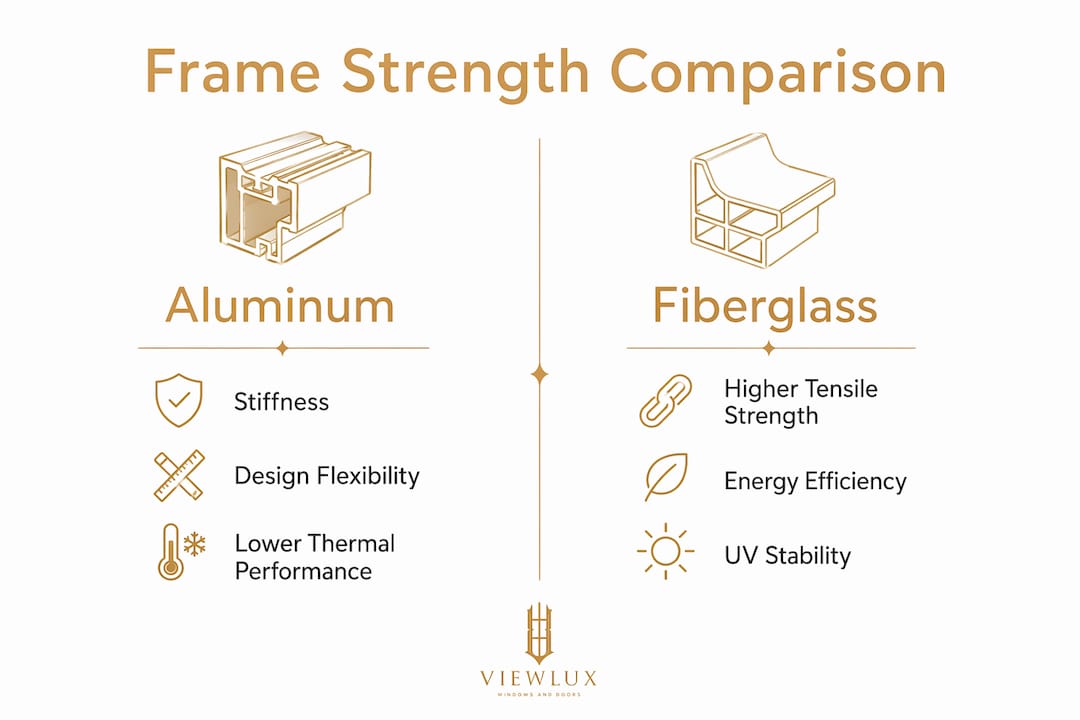
Fiberglass’s tensile strength advantage is substantial on paper, but tensile strength alone does not determine how a window frame performs under real-world loads. Stiffness, measured by elastic modulus, governs how much a frame deflects when wind pressure, structural settlement, or thermal movement acts on it. Aluminum’s elastic modulus is roughly twice that of fiberglass, which is why aluminum frames can be extruded into slimmer profiles without bending or racking under load.
Load distribution: isotropic vs. anisotropic behavior
Aluminum is isotropic, meaning its mechanical strength is uniform in every direction. A load applied vertically, horizontally, or diagonally meets the same resistance. Fiberglass pultrusions are anisotropic: strength is concentrated along the fiber direction, which is typically the length of the profile. This means fiberglass frames perform exceptionally well under lengthwise tension but require careful engineering when omnidirectional loads are expected, such as in high-wind or seismic zones.
“Fiberglass is, therefore, stronger on a pound-for-pound basis in terms of lengthwise flexural strength. This makes fiberglass an excellent consideration for an aluminum alternative for structural shapes as it provides an outstanding combination of weight and strength.” — Strongwell
Thermal conductivity and energy efficiency
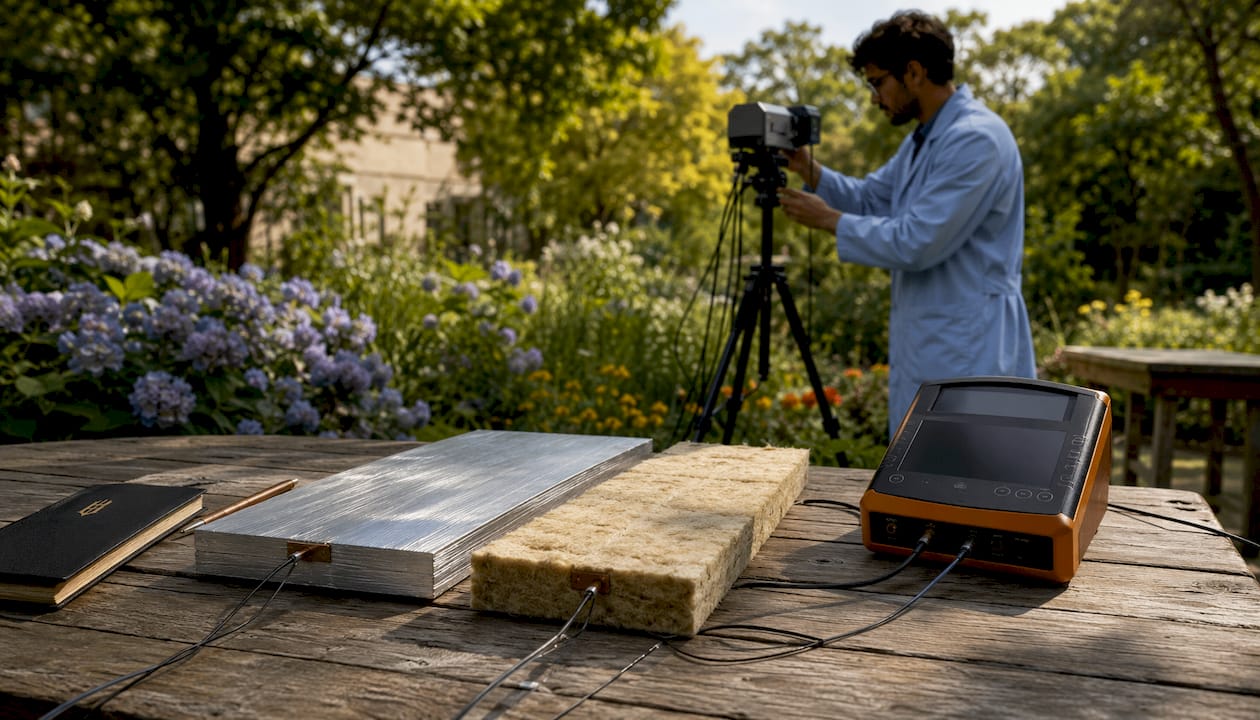
The thermal conductivity gap between these two materials is not incremental — it is transformational. Aluminum conducts heat at 167 W/m·K; fiberglass conducts at 0.3–0.5 W/m·K. Aluminum frames require thermal breaks to improve insulation, adding cost and fabrication complexity. Fiberglass achieves comparable or better insulation performance without any additional components. For projects targeting ENERGY STAR compliance or LEED credits, that difference in baseline thermal performance carries real weight.
What makes aluminum frames a strong choice — and where they fall short
Aluminum window frames have dominated commercial and modern residential architecture for decades. Their structural properties justify that position in many applications, though specific limitations require attention.
Strengths of aluminum frames:
- High elastic modulus enables slim profiles with more glass area, a defining feature of contemporary architectural design
- Isotropic strength distribution handles multidirectional loads without engineering workarounds
- Excellent formability supports complex custom shapes and large-format openings
- Aluminum is fully recyclable, with a well-established recycling infrastructure in the U.S.
- Consistent dimensional tolerances from extrusion manufacturing support precision installation
- Pairs well with advanced glazing systems, including triple-pane and laminated units
Limitations to account for:
- Thermal conductivity of 167 W/m·K requires thermal breaks in most climate zones to meet energy codes
- Susceptible to pitting and galvanic corrosion without proper anodizing or powder-coat protection
- Higher thermal expansion rate than glass can cause frame-to-glass stress in extreme temperature swings
- Powder-coat finishes, while durable, can chip or fade in UV-intensive environments without premium coatings
- Condensation on interior frame surfaces is a risk in cold climates when thermal breaks are inadequate
Pro Tip: In coastal or high-humidity regions, specify aluminum frames with a marine-grade anodized finish or PVDF powder coat rather than standard polyester. The upgrade cost is modest; the corrosion protection difference over a 20-year period is significant.
Architects frequently select aluminum for its ability to deliver floor-to-ceiling glazing with minimal visible framing. The material’s stiffness-to-weight ratio supports large structural openings that fiberglass profiles, with their thicker cross-sections, cannot match at the same visual scale.
Where fiberglass frames deliver a clear performance advantage
Fiberglass window frames have gained considerable ground in premium residential and high-performance building projects. Their combination of tensile strength, thermal stability, and corrosion immunity addresses limitations that aluminum frames cannot resolve without added cost.
Strengths of fiberglass frames:
- Tensile strength of 600–2,000 MPa provides exceptional resistance to impact and mechanical stress
- Thermal conductivity of 0.3–0.5 W/m·K delivers natural insulation without thermal breaks
- Coefficient of thermal expansion closely matches glass, reducing frame-to-glass stress and warping across temperature cycles
- Corrosion-immune construction requires no protective coatings, even in salt-air or chemically aggressive environments
- Color is typically integrated through the material or a factory-applied finish, reducing visible wear over time
- Both materials last 30–50 years under normal service conditions, though fiberglass tends to require less maintenance to reach that threshold
Limitations worth noting:
- Thicker profile cross-sections reduce visible glass area compared to aluminum, a meaningful trade-off in design-forward projects
- Higher upfront cost than aluminum in most U.S. markets
- Fewer color and finish options than aluminum, which supports a broader range of architectural palettes
- Anisotropic fiber structure requires engineering review for applications with complex or omnidirectional load paths
- Repair and custom fabrication are more specialized than aluminum, which has a larger contractor base
Pro Tip: For coastal California, Gulf Coast, or high-altitude Colorado installations, fiberglass frames eliminate the corrosion maintenance cycle entirely. Over a 10-year period, the reduced upkeep cost often offsets the higher purchase price.
The fiberglass frame benefits in energy performance are particularly relevant as U.S. building codes tighten. Projects pursuing NFRC-certified U-factor targets below 0.30 find fiberglass frames easier to spec without additional thermal components.
How climate zone affects which frame material performs better
U.S. climate zones create meaningfully different performance demands. A frame that excels in Phoenix may underperform in Minneapolis or Miami. Both aluminum and fiberglass have distinct climate profiles.
Hot, dry climates (Southwest U.S.)
- Aluminum performs well structurally; UV exposure and thermal cycling are the primary concerns
- Powder-coat finishes on aluminum can fade over time without UV-stable PVDF coatings
- Fiberglass’s matched thermal expansion with glass reduces stress cracking in high-temperature swings
- Both materials handle low-humidity environments without corrosion concerns
Humid coastal climates (Gulf Coast, Pacific Coast, Southeast)
- Aluminum requires anodizing or marine-grade coatings to resist salt-air corrosion; uncoated aluminum pits within years in these environments
- Fiberglass is corrosion-immune and requires no additional treatment, making it the lower-maintenance choice
- High humidity accelerates galvanic corrosion where aluminum contacts dissimilar metals at fastener points
- Fiberglass’s dimensional stability under humidity fluctuation reduces seal degradation at the frame-to-glass interface
Cold climates (Upper Midwest, Mountain West, Northeast)
- Aluminum’s high thermal conductivity creates condensation risk on interior frame surfaces in cold climates without adequate thermal breaks
- Fiberglass’s low thermal conductivity naturally limits condensation, improving interior comfort and reducing moisture damage risk
- Both materials handle freeze-thaw cycles well when properly installed, but fiberglass’s thermal expansion match with glass reduces long-term seal stress
- Aluminum windows in California mountain regions benefit from thermal break specifications that bring performance closer to fiberglass baselines
UV degradation and color retention
- Fiberglass with integral pigmentation or factory-applied coatings resists UV fading better than standard powder-coat aluminum
- High-quality PVDF powder-coat aluminum finishes significantly close this gap
- Both materials outperform vinyl in UV stability at elevated temperatures
Installation, maintenance, and expected lifespan
Practical ownership of either frame type involves distinct handling, upkeep, and longevity considerations that affect total project cost.
Installation differences:
- Aluminum frames are lighter per linear foot than fiberglass profiles of equivalent structural depth, simplifying handling on multi-story projects
- Aluminum’s precision extrusion tolerances support faster field installation with fewer shimming adjustments
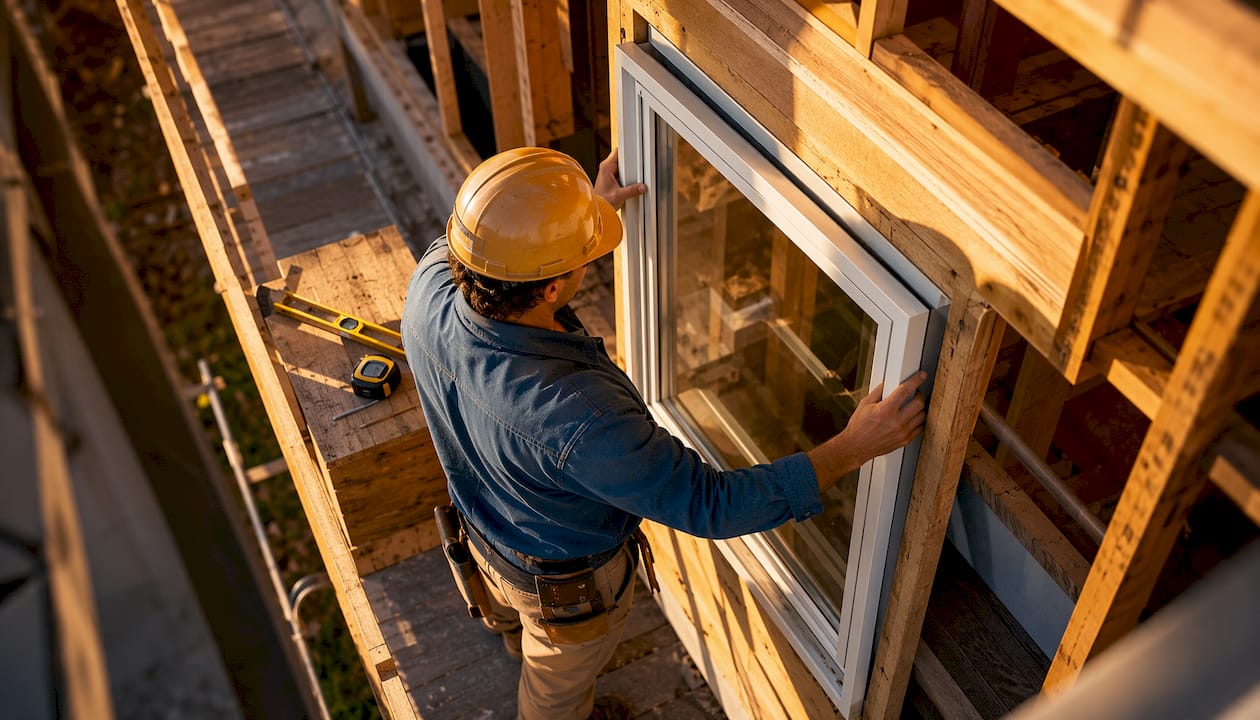
- Fiberglass frames, due to thicker profiles, require more precise rough opening sizing; retrofit applications may need framing modifications
- Both materials accept standard sealants and flashing systems used in U.S. residential construction
Maintenance requirements:
- Aluminum: inspect and touch up powder-coat or anodized finish every 5–10 years depending on climate; clean with mild soap and water; check thermal break integrity on older units
- Fiberglass: clean with mild soap and water; inspect factory finish for UV wear every 10 years; no coating renewal typically required in the first 20 years
- Hardware and weatherstripping maintenance is identical for both frame types
Lifespan and warranty:
- Both aluminum and fiberglass frames generally have long service lives under normal conditions
- Aluminum frames in coastal environments without marine-grade finishes may require earlier frame replacement or refinishing
- Fiberglass frames in high-UV environments may show surface chalking after 15–20 years without UV-stable topcoats, though structural integrity is unaffected
- For new construction, both materials are compatible with standard building envelope warranties; for retrofit, confirm compatibility with existing structural framing
The aluminum windows ROI calculation for homeowners should factor in finish maintenance costs over the ownership period, particularly in coastal or high-UV climates where aluminum’s protective coating requires periodic attention.
Cost comparison: upfront price vs. long-term value
Frame material cost involves more than the purchase price. Energy performance, maintenance frequency, and lifespan all affect the total ownership equation.
Upfront cost:
- Aluminum frames are generally less expensive per unit than fiberglass at comparable sizes and performance levels
- The cost gap widens for large-format or custom openings, where aluminum’s fabrication infrastructure is more established and competitive
- Fiberglass frames carry a premium that reflects material cost, specialized manufacturing, and lower production volume in the U.S. market
Lifecycle cost factors:
- Aluminum frames in demanding climates require periodic coating maintenance; fiberglass frames typically do not
- Fiberglass’s superior thermal performance reduces HVAC load, translating to measurable energy savings over a 10–30 year period
- Aluminum frames with thermal breaks approach fiberglass energy performance but at added upfront cost, partially closing the lifecycle gap
- Both materials reach the 30–50 year service life threshold, so replacement frequency is comparable under normal conditions
Long-term value considerations:
- Energy-efficient windows contribute to home resale value; fiberglass frames with low U-factors may support stronger appraisal outcomes in energy-conscious markets
- Aluminum’s design flexibility and modern aesthetic command premium positioning in architectural projects, supporting property value through design appeal
- For builders and developers, aluminum’s lower initial cost and faster installation often favor project economics on large-scale builds
- Fiberglass is the stronger choice where maintenance minimization and energy code compliance are the primary budget drivers
A detailed aluminum window cost comparison across manufacturers helps builders and homeowners identify where direct-to-consumer pricing models deliver the most value relative to traditional dealer channels.
Viewluxwindows: certified aluminum frame quality built to perform
Viewluxwindows manufactures aluminum window frames through a precise 26-step production process, with every unit certified to NFRC and AAMA standards. NFRC certification verifies independently tested thermal performance values, including U-factor and solar heat gain coefficient. AAMA certification confirms structural integrity, air infiltration resistance, and water penetration performance under standardized test conditions. These certifications are not marketing claims — they are third-party verified performance benchmarks that architects and building officials rely on for specification and code compliance.
Viewluxwindows’s direct-to-consumer model delivers savings of up to 50% compared to traditional dealer pricing, without compromising the certification standards or manufacturing precision that professional projects require.
Key quality attributes of Viewluxwindows aluminum frames:
- 26-step production process covering extrusion, surface treatment, thermal break integration, glazing bead fitting, and quality inspection
- NFRC-certified U-factor and SHGC values supporting ENERGY STAR and code compliance documentation
- AAMA-certified structural and weatherization performance for residential and light commercial applications
- Slim profiles enabled by aluminum’s stiffness maximize glass area in modern architectural designs
- Full range of powder-coat and anodized finishes, including options suited to coastal and high-UV environments
- Showrooms across California, Colorado, and Nevada for direct specification review
The manufacturing precision behind each frame reflects the same engineering discipline that makes aluminum the preferred material for large-format, design-forward window systems. For builders and architects specifying custom luxury home windows, Viewluxwindows’s certified production process provides the documentation trail that high-end projects demand. The fabrication precision behind aluminum extrusion and CNC-finished profiles directly supports the tight tolerances that AAMA-certified performance requires.
Key Takeaways
Fiberglass leads in tensile strength and thermal performance, while aluminum leads in stiffness and design flexibility — and the right choice depends on climate, budget, and architectural priorities.
| Point | Details |
|---|---|
| Tensile strength vs. stiffness | Fiberglass reaches 600–2,000 MPa tensile strength; aluminum delivers 69–72 GPa elastic modulus for superior stiffness. |
| Corrosion and maintenance | Fiberglass is corrosion-immune; aluminum requires coatings in coastal or humid climates to reach comparable durability. |
| Thermal performance | Fiberglass conducts heat at 0.3–0.5 W/m·K vs. aluminum’s 167 W/m·K, giving fiberglass a natural insulation advantage. |
| Lifespan and cost | Both materials last 30–50 years; aluminum costs less upfront, while fiberglass reduces long-term maintenance and energy costs. |
| Viewluxwindows aluminum frames | NFRC- and AAMA-certified, produced through a 26-step process, and available direct-to-consumer at up to 50% below dealer pricing. |
Premium aluminum windows, direct from the manufacturer
Homeowners, builders, and architects who have weighed the fiberglass vs. aluminum strength trade-offs and prioritized structural precision, design flexibility, and certified performance have a direct path to that combination through Viewluxwindows.
Viewluxwindows supplies NFRC- and AAMA-certified aluminum window frames directly to consumers, cutting out the dealer markup and delivering savings of up to 50% on premium-grade products. Every frame moves through a 26-step production process that covers thermal break integration, surface finishing, and glazing bead precision — the same manufacturing discipline that architects and building officials require for specification sign-off. For projects where slim profiles, large glass areas, and modern aesthetics are non-negotiable, Viewluxwindows’s aluminum systems deliver without the traditional dealer premium.
Showrooms are available across California, Colorado, and Nevada for direct product review and specification consultation. To see the full range of certified aluminum window packages built for upscale residential construction, visit the residential window packages page or request a quote through the product catalog for detailed specifications and pricing.


