
Aluminum window system thermal performance is defined by the frame’s ability to resist heat transfer, and that resistance depends almost entirely on thermal breaks. Standard aluminum frames carry U-values between 5.7 and 7.0 W/m²K, making them among the worst-performing frame materials without intervention. Modern thermally broken frames cut that figure by 50–70%, bringing frame U-values down to the 0.88–1.5 W/m²K range required by energy codes and Passive House standards. For homeowners and builders specifying aluminum systems, understanding what drives that reduction is the difference between a window that meets code on paper and one that delivers real comfort year-round.
What are thermal breaks and how do they improve aluminum window thermal performance?
Aluminum conducts heat at 160–205 W/m·K. That figure is roughly 600 times higher than wood and makes bare aluminum frames a direct highway for heat to escape in winter or enter in summer. A thermal break solves this by inserting a low-conductivity barrier inside the frame profile, physically separating the interior and exterior aluminum shells.
The standard material for this barrier is polyamide 66 reinforced with 25% glass fiber, known as PA66 GF25. This material conducts heat at just 0.25–0.35 W/m·K, roughly 500 times less than the aluminum surrounding it. The break is mechanically locked into the aluminum extrusions using a roll-crimping process, creating a structurally sound assembly that does not compromise the frame’s load-bearing capacity.

The geometry of the break matters as much as the material. Simple single-cavity designs use one strip of polyamide. Multi-cavity designs add internal chambers that trap still air, which is itself a poor conductor. Each additional cavity reduces the number of direct conduction paths through the frame cross-section.
Key factors that determine how well a thermal break performs:
- Break material: PA66 GF25 is the industry standard; resin composites are emerging for higher performance.
- Break width: Wider breaks create longer conduction paths and lower frame U-values.
- Cavity count: Multi-cavity profiles outperform single-strip designs at the same width.
- Profile depth: Deeper profiles accommodate wider breaks but increase sightline width.
- Surface emissivity: Low-emissivity coatings inside frame cavities reduce radiant heat transfer.
Pro Tip: Ask your supplier for a certified cross-section drawing that shows the break location, width, and cavity count. A verbal claim of “thermally broken” tells you nothing about actual performance.
How does thermal break width affect aluminum window insulation?
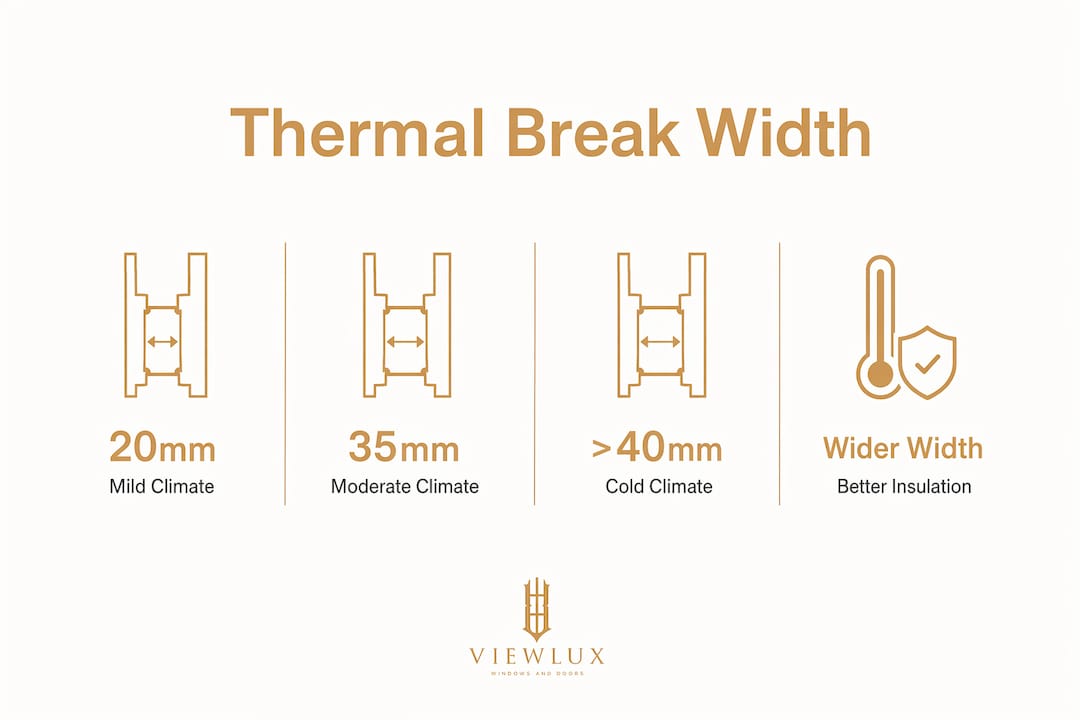
Break width is the single most controllable variable in frame thermal design. A 20mm break suits mild climates and delivers frame U-values in the 2.0–2.8 W/m²K range. Pushing that width to 40–50mm, combined with multi-cavity geometry, can drive frame Uf values below 1.0 W/m²K in advanced systems. That is the threshold required for Passive House certification in most North American and European climate zones.
The relationship between width and performance is not linear. Gains are steep from 20mm to 35mm, then taper off. Beyond 50mm, the structural demands on the polyamide strip increase significantly, and profile depth grows in ways that affect sightlines and glazing bead geometry. Builders working on high-rise or large-span projects need to confirm that wider-break profiles still meet structural load requirements.
| Thermal break width | Typical frame Uf (W/m²K) | Suitable climate zone |
|---|---|---|
| 20mm | 2.0–2.8 | Mild (IECC zones 1–2) |
| 28–32mm | 1.5–2.0 | Mixed (IECC zones 3–4) |
| 36–40mm | 1.0–1.5 | Cold (IECC zones 5–6) |
| 45–50mm+ | 0.6–1.0 | Very cold / Passive House |
Advanced thermal breaks can exceed 40mm and incorporate aerogel or polyurethane foam inserts inside the polyamide cavity. Aerogel is particularly effective because its thermal conductivity sits below 0.02 W/m·K, lower than still air. These inserts push frame Uf values well below 1.0 W/m²K without requiring impractical profile depths. For builders specifying windows in IECC climate zones 5 and above, this technology is worth requesting by name in the performance specification.
What whole-window thermal metrics should homeowners and builders evaluate?
The frame U-value alone does not tell the full story. The metric that governs energy code compliance and Passive House certification is the whole-window U-value, written as Uw. Certified Uw values account for three separate heat loss paths: through the glass center pane (Ug), through the frame (Uf), and along the glass edge where the spacer bar sits (expressed as the linear thermal bridge value, Psi).
Relying on the center-pane glass U-value alone is a common and costly mistake. A triple-glazed unit might show a Ug of 0.5 W/m²K, but once frame losses and edge losses are included, the whole-window Uw can be 0.8–1.0 W/m²K or higher. That gap matters when you are trying to meet a code requirement or a Passive House target.
Warm-edge spacers address the edge loss problem directly. Conventional aluminum box spacers conduct heat efficiently at the glass perimeter. Replacing them with warm-edge spacers made from stainless steel, foam, or hybrid materials reduces Psi-values from 0.08–0.10 W/mK down to 0.03–0.05 W/mK. That reduction alone can improve the whole-window Uw by 0.08–0.12 W/m²K. For a large window, that is a meaningful difference in annual heating and cooling load.
Pro Tip: Request the NFRC label or PHI-certified data sheet for any window you are specifying. Both certifications require third-party testing of the complete assembly, not just the glass unit.
Certification bodies that publish reliable whole-window data include the National Fenestration Rating Council (NFRC), the Passive House Institute (PHI), and ISO 10077. Each uses a standardized calculation method that accounts for Uf, Ug, and Psi together. Specifying by certified Uw rather than glass-only Ug is the single most effective step homeowners and builders can take to get accurate performance data. You can also review energy-efficient glazing options to understand how spacer and glass choices interact with frame performance.
How do modern aluminum windows meet Passive House and energy code standards?
High-performance thermally broken aluminum windows can achieve whole-window U-values as low as 0.72–0.74 W/m²K with triple glazing and advanced thermal breaks. That figure meets Passive House Institute certification requirements for most North American climate zones. Reaching it requires coordinating four elements: a wide thermal break (35mm or more), triple glazing with low-e coatings, warm-edge spacers, and precise installation.
Installation quality is where many otherwise well-specified projects lose performance. The wall-to-window interface creates its own thermal bridge, measured as Psi-install. Passive House targets for this value are ≤0.04 W/mK at the head, ≤0.05 W/mK at the sill, and ≤0.03 W/mK at the jambs. Hitting those targets requires continuous insulation wrapping the frame perimeter and airtight sealing at every joint. A well-designed window installed carelessly will underperform a modest window installed correctly.
Aluminum also holds structural and durability advantages that matter for long-term energy performance. The frame does not warp, swell, or shrink with moisture changes the way wood does. Corrosion resistance means the thermal break assembly maintains its geometry over decades. For builders working on Passive House and NZEB projects, thermally broken aluminum now competes directly with PVC on thermal performance while offering slimmer sightlines and the ability to span larger glass areas.
Key requirements for Passive House-compliant aluminum window installation:
- Triple glazing with a center-pane Ug of 0.5 W/m²K or lower
- Warm-edge spacers with Psi ≤0.05 W/mK
- Frame Uf of 1.0 W/m²K or lower, certified by PHI or equivalent body
- Continuous insulation at the frame perimeter to control Psi-install
- Airtight membrane sealing at all four sides of the rough opening
- Third-party verified whole-window Uw of 0.80 W/m²K or lower for most North American climates
Avoiding thermal bridging at construction joints is as critical as the window specification itself. Even a certified product loses its rated performance if the surrounding wall assembly creates uncontrolled heat paths.
What should homeowners and builders check when specifying aluminum windows?
Specification errors are the most common reason thermally efficient aluminum windows fail to deliver their rated performance in the field. Energy code compliance requires coordinated specification of frame thermal breaks, glazing properties, and installation details. Getting one element right while neglecting the others leaves performance on the table.
Follow this sequence when specifying aluminum window systems for thermal performance:
- Specify certified Uw, not Ug. Write the whole-window U-value requirement into the specification, and require NFRC or PHI certification to verify it.
- Request cross-section drawings. The drawing should show break width, cavity count, and spacer type. If a supplier cannot provide this, treat that as a red flag.
- Confirm warm-edge spacers. Specify by name or by Psi-value requirement (≤0.05 W/mK). Aluminum box spacers do not meet this threshold.
- Check climate zone requirements. IECC zone 5 and above typically require Uw ≤1.2 W/m²K for compliance. Passive House targets are stricter, often ≤0.80 W/m²K.
- Review the installation specification. Require airtight membrane sealing and continuous perimeter insulation. Reference the installation sequence in the project documentation.
- Request third-party test reports. Manufacturer-calculated values and tested values can differ. Tested data from an accredited laboratory is the standard for compliance documentation.
Pro Tip: After installation, inspect the interior frame surface in cold weather. Condensation forming on the frame face indicates a thermal bridge at the break or at the wall interface. Address it before finishing the interior.
Maintenance also affects long-term thermal integrity. The PA66 GF25 polyamide strip is durable, but sealant at the frame-to-wall joint degrades over time. Inspect and re-seal perimeter joints every 7–10 years to preserve airtightness and prevent moisture infiltration that can degrade insulation in the wall assembly.
Key Takeaways
Thermal break width, certified whole-window U-values, warm-edge spacers, and precise installation together determine whether an aluminum window system delivers its rated thermal performance in a real building.
| Point | Details |
|---|---|
| Thermal breaks cut frame losses by 50–70% | PA66 GF25 polyamide breaks reduce frame Uf from 5.7–7.0 down to 0.88–1.5 W/m²K. |
| Specify Uw, not Ug | Whole-window U-value includes frame and edge losses; glass-only values understate real heat loss. |
| Break width drives performance | Widths of 40–50mm with multi-cavity design push frame Uf below 1.0 W/m²K for cold climates. |
| Warm-edge spacers improve Uw by up to 0.12 W/m²K | Replacing aluminum box spacers reduces edge Psi-values from 0.08–0.10 to 0.03–0.05 W/mK. |
| Installation quality is non-negotiable | Psi-install targets of ≤0.04 W/mK at the head require continuous insulation and airtight sealing. |
What I’ve learned after years of watching aluminum window specs go wrong
The most persistent mistake I see in residential projects is treating the window as a product decision rather than a system decision. A builder selects a thermally broken aluminum frame with excellent certified numbers, then hands the installation off to a crew that has never read the airtightness specification. The result is a window that tests well in a laboratory and underperforms in the field.
The second mistake is specification by brand reputation rather than certified data. Thermal break technology has advanced rapidly. A product line that was considered high-performance five years ago may now sit in the middle of the market. The only reliable way to compare is to put certified Uw values side by side, from the same certification body, tested under the same standard.
What I find genuinely interesting about where this technology is heading is the aerogel insert. Aerogel has been used in aerospace insulation for decades, and it is now appearing in commercial aluminum window profiles. The thermal conductivity of aerogel is lower than still air, which means it outperforms any conventional foam or gas-filled cavity at the same thickness. Builders specifying windows for IECC zone 6 or Passive House projects in cold climates should ask suppliers specifically whether aerogel-enhanced breaks are available in their product line.
The regulatory direction is also clear. Energy codes in California, Colorado, and Nevada are tightening Uw requirements on a two-to-three-year revision cycle. Specifying to today’s minimum means the building may fall short of the next code cycle before the windows reach the end of their service life. Specifying to Passive House targets now is the most durable investment a homeowner or builder can make. Viewluxwindows carries NFRC and AAMA certifications, which means the certified data exists and is independently verified. That is the baseline any serious specification should require.
— Liran
Viewluxwindows aluminum systems built for thermal performance
Viewluxwindows designs and manufactures thermally broken aluminum window systems certified under NFRC and AAMA standards, with products capable of meeting Passive House whole-window Uw targets. Every system goes through a 26-step production process that controls thermal break geometry, glazing bead fit, and airtightness details from the factory.

Homeowners and builders across California, Colorado, and Nevada can review upscale residential window packages that include certified performance data for each configuration. Viewluxwindows sells direct to consumers, removing dealer markups and making certified high-performance systems accessible at a price point that competes with standard-grade alternatives. To discuss a specific project or request certified thermal data for a product configuration, get a quote directly from the Viewluxwindows team.
FAQ
What is a thermal break in an aluminum window frame?
A thermal break is a low-conductivity barrier, typically PA66 GF25 polyamide, inserted between the interior and exterior aluminum shells of a window frame. It interrupts the metal’s conduction path and reduces frame U-values by 50–70%.
What U-value should I specify for an aluminum window in a cold climate?
For IECC climate zones 5 and above, specify a certified whole-window Uw of 1.2 W/m²K or lower. Passive House projects require Uw at or below 0.80 W/m²K, achievable with 40mm-plus thermal breaks and triple glazing.
Why does the whole-window U-value differ from the glass U-value?
The glass center-pane U-value (Ug) excludes heat loss through the frame and along the glass edge. The whole-window U-value (Uw) includes all three loss paths and is the correct metric for energy code compliance and Passive House certification.
What are warm-edge spacers and why do they matter?
Warm-edge spacers replace conventional aluminum box spacers at the glass perimeter, reducing edge Psi-values from 0.08–0.10 W/mK to 0.03–0.05 W/mK. That reduction improves the whole-window Uw by up to 0.12 W/m²K.
Does aluminum window fire rating depend on the frame alone?
No. Fire-rated aluminum window assemblies require integrated certification of the frame, hardware, and glazing together. The aluminum frame alone does not confer a fire rating; the complete tested assembly must carry the certification.
Recommended
- European Aluminum Window System Selection Guide 2026 – ViewLux Windows And Doors, Inc.
- Aluminum Window Installation Sequence: 2026 Builder Guide – ViewLux Windows And Doors, Inc.
- Custom Aluminum Door Configurations Explained for Builders – ViewLux Windows And Doors, Inc.
- Aluminum Windows ROI Explained for Homeowners in 2026 – ViewLux Windows And Doors, Inc.


