
European aluminum window system selection is defined as the process of evaluating complete window assemblies based on whole-window thermal performance, airtightness ratings, and structural design to meet energy and durability targets. Homeowners and builders who focus only on glass specifications miss the larger picture. Systems like the Schüco AWS 75, Exlabesa ARS-82, and Zyle Fenster alu-clad Passivhaus windows demonstrate that frame design, thermal breaks, and installation quality determine real-world performance. The industry term for this evaluation process is “window system specification,” and it covers every component from the polyamide thermal break to the gasket seal.
What makes whole-window thermal performance the key selection metric?
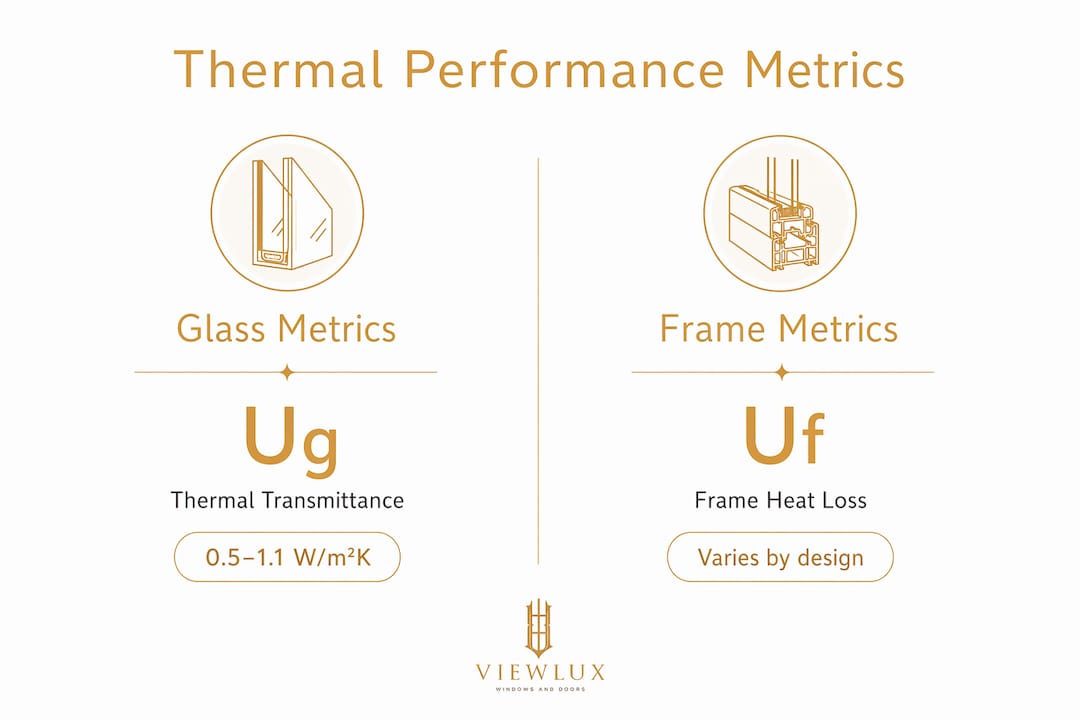
The Uw value is the single most important number in window specification. It measures the combined heat transfer of the glass, the frame, and the edge effects where glass meets frame. The glass-only Ug value tells you nothing about how the full assembly performs once installed in a wall.
Windows can account for 40–50% of total heat loss in a well-insulated building. That figure holds even when walls are insulated to U=0.20 W/m²K and roofs to 0.15 W/m²K. Selecting a window with a low Ug but a poorly designed frame can still produce a high Uw and significant energy loss.
Three separate values feed into the final Uw calculation:
- Ug: Thermal transmittance of the glass unit only
- Uf: Thermal transmittance of the frame material
- Ψ (psi): Linear thermal transmittance at the glass edge, affected by spacer bar type
Warm-edge spacers improve Uw by approximately 0.1 W/m²K compared to conventional aluminum spacers. That improvement is significant when targeting near-zero energy building (nZEB) thresholds of Uw ≤ 0.85 W/m²K.
| Metric | What it measures | Typical range |
|---|---|---|
| Ug | Glass unit only | 0.5–1.1 W/m²K |
| Uf | Frame only | 0.9–1.4 W/m²K |
| Uw | Full window assembly | 0.74–1.2 W/m²K |
Aluminum frames carry a reputation for high conductivity, but certified Passivhaus systems close that gap. The Exlabesa ARS-82 achieves Uf = 0.978 W/m²K through multi-chamber profiles and polyamide thermal breaks. The Zyle Fenster alu-clad Passivhaus window reaches Uw ≈ 0.79 W/m²K using triple glazing with dual Low-E coatings and warm-edge spacers.
Pro Tip: Always request the certified Uw value for the specific glazing package you plan to use. Manufacturers often publish Uw figures based on a reference glass unit that may differ from your project specification.
How do European airtightness and watertightness standards affect system selection?
Airtightness is classified under EN 12207, which runs from Class 0 (no performance requirement) to Class 4 (highest performance). Class 4 limits air leakage to ≤ 3 m³/(h·m²) at 100 Pa, tested per EN 1026 using pressurized air on a mounted specimen. Watertightness is tested under EN 1027, which simulates simultaneous rain and wind pressure to verify that no water penetrates the sealed assembly.
From a builder’s perspective, these classifications appear in a window’s Declaration of Performance (DoP) as a string such as Class 4/E1950/C5. Each segment refers to a different performance category. Requesting the full DoP from a manufacturer is the fastest way to verify that marketing claims match tested results.
Key classifications to request from any European aluminum window supplier:
- Air permeability: EN 12207 Class 4 for high-performance projects
- Watertightness: EN 1027 with pressure rating appropriate to local wind exposure
- Wind resistance: EN 12210 for structural integrity under load
- Mechanical strength: EN 13115 for hardware and hardware attachment points
Achieving the rated airtightness in a real building depends entirely on installation quality. A window certified to Class 4 in a lab can perform at Class 1 levels if gaps exist around the frame perimeter. Verification of EN classifications through DoP documentation is the starting point, but professional installation is what locks in that performance on site.
Installation quality directly affects actual airtightness. Gaps, compressed gaskets, or misaligned sill flashings can nullify the lab-tested classification. Builders should treat the installation detail as part of the window system specification, not a separate trade concern.
Which design features optimize energy efficiency and durability?
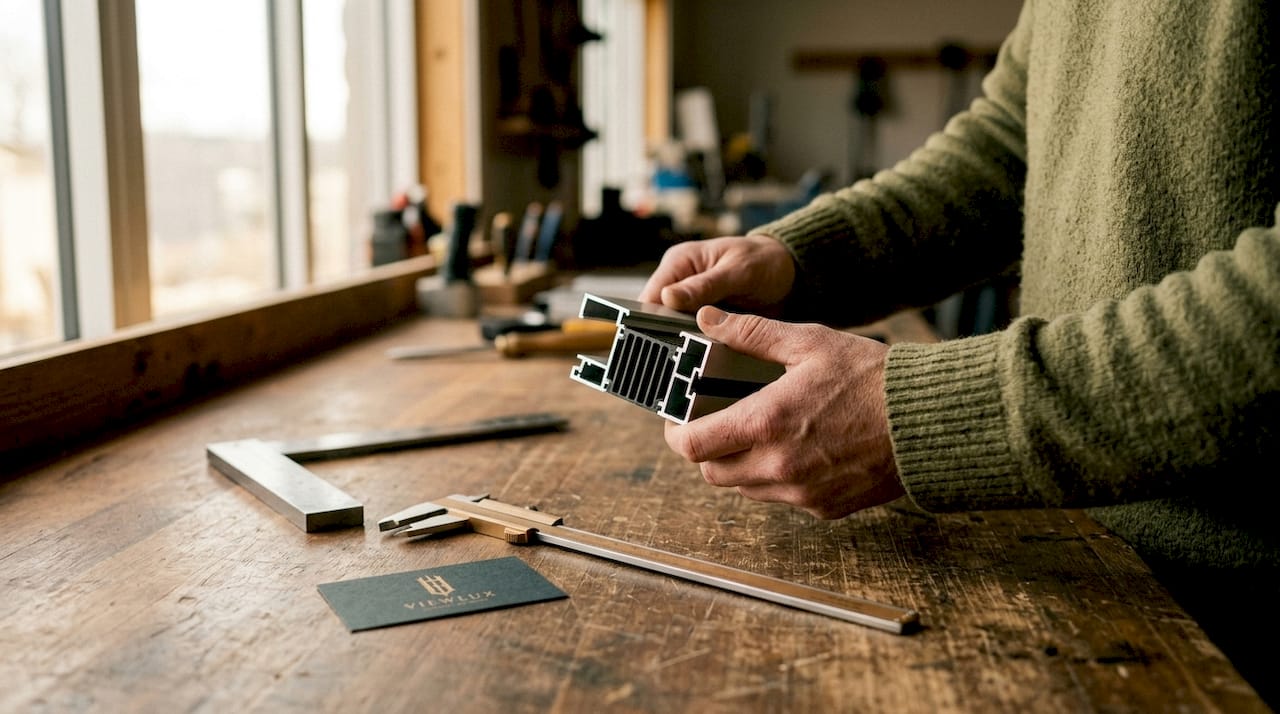
Thermal breaks made from polyamide are the foundation of high-performance aluminum window frames. Polyamide conducts heat at roughly 0.3 W/m²K compared to aluminum at 160 W/m²K. That difference allows frame designers to create multi-chamber profiles that interrupt the conductive path between the interior and exterior aluminum skins.
Triple glazing and Low-E coatings
Triple glazing with dual Low-E coatings is the standard configuration for Passive House level aluminum windows. Thermal bridge control at the frame level is equally critical. A high-performance glass unit installed in a thermally weak frame still produces a poor Uw. The Zyle Fenster alu-clad system addresses this by combining timber inner frames with aluminum cladding, reducing thermal bridging at the sill and jamb while maintaining the exterior durability of aluminum.
Frame geometry and spacer bars
Frame geometry determines how much of the window area is frame versus glass. Wider frames reduce the visible glass area and can increase the proportion of the assembly with higher Uf values. Stainless steel or polymer warm-edge spacer bars reduce edge-based heat loss and are standard in any system targeting Uw below 0.85 W/m²K.
A structured approach to evaluating design features:
- Confirm thermal break material. Polyamide breaks with a minimum width of 24 mm are standard in Class A thermal performance systems.
- Check spacer bar specification. Stainless steel or thermoplastic spacers outperform aluminum in edge-of-glass heat loss.
- Verify glazing unit configuration. Triple glazing with argon or krypton fill and dual Low-E coatings is required for Uw below 0.85 W/m²K.
- Review frame geometry. Narrower sightlines increase glass area but require stiffer profiles to maintain structural ratings.
- Assess hardware and concealment options. The ARS-82 system includes concealed hardware and micro-ventilation, which preserves clean sightlines without compromising air sealing.
| Feature | Standard system | Passivhaus system |
|---|---|---|
| Thermal break | Polyamide, 12–20 mm | Polyamide, 24+ mm |
| Glazing | Double Low-E | Triple dual Low-E |
| Spacer bar | Aluminum | Stainless steel or polymer |
| Uf (frame) | 1.2–1.4 W/m²K | Below 1.0 W/m²K |
| Uw (assembly) | 1.0–1.2 W/m²K | 0.74–0.85 W/m²K |
Powder coat finishes on aluminum frames add corrosion resistance and color stability without affecting thermal performance. A quality powder coat applied to a pre-treated aluminum substrate resists UV degradation and salt spray, making it the preferred finish for coastal and high-humidity climates.
Pro Tip: Ask for the system’s tested Uf value at the specific thermal break width used in your configuration. Manufacturers sometimes publish best-case Uf figures based on maximum break widths that are not standard in every profile.
How to evaluate and select the best European aluminum window system for your project
Selecting the right system requires a structured comparison across thermal, airtightness, and installation criteria. Relying on a single specification sheet or a sales presentation is not enough.
Follow this sequence when comparing systems:
- Request the full Declaration of Performance. The DoP lists EN 12207, EN 1027, EN 12210, and EN 13115 classifications for the specific tested configuration.
- Compare Uw values for your glazing package. Ask manufacturers to calculate Uw using the actual glass unit you plan to specify, not a reference unit.
- Verify Uf at your thermal break width. Confirm the polyamide break width and request the corresponding Uf figure.
- Check air permeability class. For nZEB or Passive House projects, Class 4 under EN 12207 is the minimum acceptable rating.
- Evaluate installation system compatibility. Review the manufacturer’s installation guide and confirm that the fixing system, sill flashing, and perimeter seal details are compatible with your wall construction.
Common mistakes to avoid:
- Selecting a window based on Ug alone without requesting the full Uw calculation
- Ignoring the Uf value of the frame, which can be the weakest link in the assembly
- Failing to verify that the installation contractor has experience with the specific system’s air-sealing requirements
- Overlooking warranty terms for hardware, finish, and glazing unit seal integrity
- Assuming that a higher price automatically corresponds to a higher EN classification
Treating installation as part of the system is the most overlooked factor in window specification. A correctly specified window installed poorly will underperform a mid-range window installed with precision air sealing and correct flashing details.
Pro Tip: Request a sample DoP from at least three manufacturers before finalizing your specification. Comparing DoP documents side by side reveals differences in tested configurations that are invisible in standard product brochures.
Homeowners evaluating retrofit versus new construction frames face different constraints. Retrofit installations often require adaptor frames or sub-sill extensions that affect the final Uw. New construction allows full integration of the window system into the wall assembly from the start, which is the preferred approach for achieving Passive House metrics.
Energy-efficient glazing options vary significantly in cost and performance. Triple glazing with krypton fill delivers the lowest Ug values but at a premium price. For most nZEB projects, argon-filled triple glazing with dual Low-E coatings delivers the required Uw without the cost premium of krypton.
Key Takeaways
European aluminum window system selection requires prioritizing whole-window Uw values, verified EN airtightness classifications, and professional installation to achieve real-world energy performance targets.
| Point | Details |
|---|---|
| Prioritize Uw over Ug | The whole-window Uw value includes frame and edge losses that Ug alone does not capture. |
| Require EN 12207 Class 4 | Class 4 airtightness limits leakage to ≤ 3 m³/(h·m²) at 100 Pa for high-performance projects. |
| Specify warm-edge spacers | Stainless steel or polymer spacers improve Uw by approximately 0.1 W/m²K over aluminum spacers. |
| Treat installation as part of the system | Poor installation can nullify a lab-certified Class 4 airtightness rating in real-world conditions. |
| Request the full Declaration of Performance | DoP documents reveal tested EN classifications that marketing materials often omit or obscure. |
What I have learned from years of specifying aluminum window systems
The most consistent mistake I see homeowners and builders make is treating the glass specification as the whole decision. They spend hours comparing Ug values between triple-glazed units and then accept whatever frame the supplier bundles with it. The frame is where the performance gap actually lives.
I have reviewed projects where a Uw of 1.1 W/m²K was achieved with a premium glass unit because the aluminum frame had no thermal break wider than 14 mm. The same glass unit in a properly specified Passivhaus frame would have delivered Uw below 0.85 W/m²K. That difference translates directly into heating costs and comfort levels every winter.
The second pattern I see regularly is underestimating installation. Builders who specify Class 4 airtightness systems and then hand installation off to a general contractor without specific air-sealing training are wasting their specification budget. The window is only as good as the perimeter seal around it.
Aluminum systems do have a genuine advantage over timber and uPVC in one area that rarely gets discussed: dimensional stability. Aluminum does not warp, swell, or shrink with humidity cycles. That stability is what keeps gaskets compressed and hardware aligned over a 30-year service life. For coastal California, Nevada desert climates, or Colorado altitude conditions, that durability argument is real and measurable.
My advice is to build your specification around three documents: the DoP, the manufacturer’s installation guide, and a third-party energy calculation using your actual wall assembly. If a supplier cannot provide all three, move to the next option.
— Liran
Viewluxwindows: premium aluminum window systems for your project
Viewluxwindows offers a direct-to-consumer model that removes the dealer markup, saving clients up to 50% compared to traditional distribution channels. Every system goes through a 26-step production process and carries NFRC and AAMA certifications, which means the thermal and structural performance figures are independently verified, not self-reported.

For homeowners and builders targeting nZEB or Passive House performance levels, Viewluxwindows provides custom aluminum window configurations with thermal break profiles, triple-glazing compatibility, and powder coat finish options suited to California, Colorado, and Nevada climates. Explore energy-efficient glazing options or review the aluminum windows ROI breakdown to understand the long-term value of a correctly specified system. Showrooms are available across California, Colorado at viewluxcolorado.com, and Nevada.
FAQ
What is the difference between Ug and Uw in window specifications?
Ug measures the thermal transmittance of the glass unit only, while Uw measures the full window assembly including the frame and edge effects. Uw is the client-relevant metric for energy performance.
What EN airtightness class should I specify for a high-performance home?
EN 12207 Class 4 is the highest rating and limits air leakage to ≤ 3 m³/(h·m²) at 100 Pa. It is the minimum standard for nZEB and Passive House projects.
Do aluminum windows perform as well as timber for thermal efficiency?
Certified Passivhaus aluminum systems like the Exlabesa ARS-82 and Zyle Fenster alu-clad achieve Uw values of 0.74–0.79 W/m²K, which matches or exceeds many timber systems when polyamide thermal breaks and warm-edge spacers are specified.
How much does installation quality affect window energy performance?
Installation quality is a primary factor. A Class 4 certified window installed with gaps or incorrect perimeter sealing can perform at Class 1 levels in real-world conditions, negating the value of the window specification entirely.
What documents should I request before selecting a European aluminum window system?
Request the Declaration of Performance (DoP), the manufacturer’s installation guide, and a Uw calculation based on your specific glazing package and wall assembly. These three documents together give a complete picture of real-world performance.
Recommended
- Aluminum Window Installation Sequence: 2026 Builder Guide – ViewLux Windows And Doors, Inc.
- Custom Aluminum Door Configurations Explained for Builders – ViewLux Windows And Doors, Inc.
- Aluminum Window Powder Coat Finish: 2026 Guide – ViewLux Windows And Doors, Inc.
- Aluminum Windows ROI Explained for Homeowners in 2026 – ViewLux Windows And Doors, Inc.


