
Factory direct windows are defined as windows purchased straight from the manufacturer, bypassing distributors, retailers, and any other intermediary in the supply chain. This model, formally called direct-to-consumer or direct-from-manufacturer sourcing, gives homeowners and builders direct access to production pricing. Understanding factory direct windows meaning starts with one core fact: every layer you remove from the supply chain reduces the markup you pay. Viewluxwindows operates on exactly this model, offering direct-to-consumer sales that save clients up to 50% compared to traditional dealer pricing. The savings are real, but so are the responsibilities that come with cutting out the middleman.
What is the factory direct windows meaning, and how does it work?
Factory direct purchasing eliminates the standard three-tier supply chain of manufacturer, distributor, and retailer. Instead, the buyer contracts directly with the production facility. The manufacturer controls design, fabrication, quality inspection, and shipping from a single point of contact. That single-source structure is the defining feature of the model.
The industry term for this approach is direct-from-manufacturer sourcing. It applies across product categories, but in the window industry it carries specific implications for lead times, customization, and warranty responsibility. When a distributor is removed from the chain, the buyer gains pricing transparency but takes on coordination tasks the distributor previously handled.
Factory direct sourcing primarily benefits buyers by removing middlemen friction, reducing errors and delays, rather than guaranteeing a better product on its own. The quality of the product still depends entirely on the manufacturer’s standards, certifications, and production process.

How do factory direct windows reduce project costs?
Sourcing windows factory direct eliminates distributor markups of 40–60%, saving up to $120–$200 per window on large projects exceeding 150 windows. On a 200-unit project, that translates to $24,000–$40,000 in savings before installation costs are factored in. Total project cost reductions typically land in the 25–35% range compared to distributor pricing.
The savings come from a straightforward mechanism. Distributors add margin to cover their warehousing, sales staff, and logistics operations. When you buy direct, none of those costs appear in your invoice. The manufacturer’s production cost plus shipping becomes your landed cost.
| Cost Element | Distributor Model | Factory Direct Model |
|---|---|---|
| Manufacturer price | Base cost | Base cost |
| Distributor markup | 40–60% added | Eliminated |
| Retailer margin | 15–25% added | Eliminated |
| Buyer’s landed cost | Full retail price | Production cost + shipping |
| Typical project savings | Baseline | 25–35% lower |
Trade-offs exist. Most manufacturers require minimum order quantities, and bulk ordering demands upfront capital. Buyers who cannot commit to volume orders lose the pricing advantage. Flexible timelines also matter. Rush orders rarely qualify for factory direct pricing, and production slots fill weeks in advance.
Pro Tip: Plan your window specifications at least 16 weeks before your installation date. Locking in specs early gives you access to standard production runs, which carry the lowest per-unit pricing.
Builders working on custom versus standard window specifications should note that highly custom profiles can reduce the cost gap. Standard sizes and profiles maximize factory direct savings because they fit into existing production tooling without retooling fees.
Quality and accountability advantages of buying factory direct
Factory direct purchasing improves accountability by eliminating communication gaps between manufacturers, distributors, and installers that cause sizing errors and project delays. When a sizing error occurs in a three-tier chain, responsibility gets passed between parties. With factory direct, one entity owns the error and resolves it.
The accountability structure also affects customization. Manufacturers working directly with buyers can adjust specifications, glazing configurations, and frame profiles without translating requirements through a distributor’s order system. That direct line reduces the chance of specification drift between what was designed and what gets built.
Key quality checkpoints to verify before committing to a factory direct order:
- Certifications: Confirm the manufacturer holds NFRC and AAMA certifications. These standards govern energy performance and structural integrity. Viewluxwindows carries both.
- Engineering documentation: Large projects must verify that the manufacturer provides submittal packages, CAD drawings, and structural calculations. Distributors normally handle this. If the factory does not include it, you pay for it separately.
- In-house quality inspection: Ask for the manufacturer’s inspection protocol. Facilities with integrated fabrication and in-house quality control deliver 20–30% cost savings alongside tighter product control compared to outsourced fabrication.
- Warranty terms: Confirm who holds warranty responsibility. Factory direct means the manufacturer is your warranty contact. Review the warranty coverage terms before signing any purchase agreement.
- Post-sale support: Verify that technical support is available after delivery for installation questions and field adjustments.
Pro Tip: Request a sample submittal package from the manufacturer before placing your order. If they cannot produce engineering documentation on request, that is a signal they are not equipped for commercial or large residential projects.
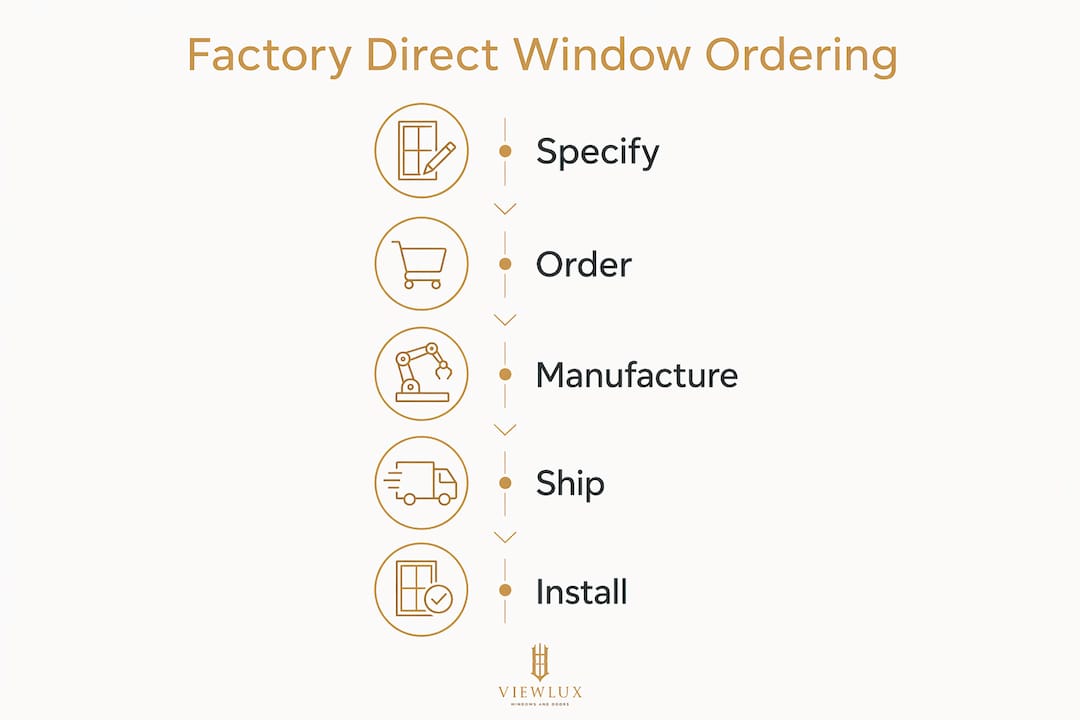
What does the factory direct window ordering process look like?
Ordering factory direct from international manufacturers can save buyers 40–60% compared to local suppliers, but requires a 12–16 week timeline for production and shipping. That timeline breaks down into roughly 20–30 days for production and 25–45 days for shipping and customs clearance. Builders who do not account for this window in their project schedule face costly delays.
The ordering process follows a defined sequence. Each step requires buyer action, not just passive waiting.
- Inquiry and specification submission. Submit window sizes, frame material, glazing type, finish color, and hardware requirements. The more complete your spec sheet, the faster the factory can quote.
- Design review and approval. The manufacturer sends shop drawings or CAD files for your review. Approve these in writing before production begins. Changes after approval typically incur fees and restart lead times.
- Deposit and production start. Most factories require a 30–50% deposit to begin production. Confirm the payment schedule in the contract before signing.
- Production monitoring. Request production photos or a factory inspection report at key milestones. This step catches defects before shipping, not after.
- Shipping and customs coordination. Contracts must specify container loading and customs clearance responsibilities. Ambiguity here creates hidden fees and shipment holds. Only the landed cost, including shipping, customs, and all fees, is the number that matters for your budget.
- Delivery and site inspection. Inspect every unit against the approved shop drawings upon delivery. Document any discrepancies immediately. Factories resolve claims faster when damage or errors are reported within the delivery window.
- Installation coordination. Factory direct sourcing requires buyers to coordinate logistics, site measurements, and code compliance. These tasks fall to you, not a distributor. Review the installation sequence requirements before your crew arrives on site.
Understanding realistic lead times is the single most common gap in factory direct planning. Buyers who treat the 12–16 week window as a suggestion rather than a hard constraint consistently face schedule overruns.
When does factory direct make sense versus buying through a distributor?
Factory direct windows work best for projects over 150 units with standard specifications and sufficient lead time. Small or highly custom projects benefit more from distributors. That threshold exists because the savings from eliminating markup only outweigh the added buyer responsibilities at sufficient volume.
Large-scale, standard projects suit factory direct best but require buyers to manage logistics and compliance actively. Buyers who lack project management capacity or in-house specification expertise often find that the time cost of managing a factory direct order erodes the financial savings.
| Scenario | Factory Direct | Distributor |
|---|---|---|
| Project size | 150+ windows | Under 50 windows |
| Specifications | Standard profiles | Highly custom or complex |
| Timeline | Flexible, 16+ weeks | Tight or rush schedule |
| Buyer capacity | Strong project management | Limited coordination resources |
| Budget priority | Cost savings primary | Speed and service primary |
The decision is not about which model is better in the abstract. It is about matching the model to your project’s actual constraints. A 200-unit multifamily project with a standard aluminum profile and a six-month timeline is an ideal factory direct scenario. A 12-window custom residential remodel with a 10-week deadline is not.
Key Takeaways
Factory direct windows deliver the strongest results when buyers combine volume orders, standard specifications, and realistic lead times with active project management.
| Point | Details |
|---|---|
| Cost savings are volume-dependent | Eliminating distributor markups saves 25–35% on projects exceeding 150 windows. |
| Accountability improves with fewer parties | Single-source purchasing reduces sizing errors and speeds up issue resolution. |
| Lead times require early planning | The full ordering cycle runs 12–16 weeks; late spec approval restarts the clock. |
| Engineering docs are buyer’s responsibility | Confirm submittal packages and CAD support are included before signing any contract. |
| Project size determines model fit | Small or rush projects typically cost less and move faster through a distributor. |
What I have learned about factory direct windows after years in the field
The biggest misconception I see from homeowners and builders is that factory direct automatically means better quality. It does not. It means better pricing and clearer accountability, which are valuable on their own terms. Quality still depends on the manufacturer’s certifications, production standards, and inspection process.
The second misconception is that factory direct is passive. Buyers who treat it like a retail purchase, submit an order and wait, consistently run into problems. The model rewards buyers who stay engaged: reviewing shop drawings carefully, confirming production milestones, and coordinating delivery logistics with precision.
What I have found genuinely undervalued is the single-source accountability structure. When one entity designs, builds, and ships your windows, there is no finger-pointing when something goes wrong. That clarity alone has saved projects I have worked on from turning minor defects into months-long disputes.
My practical advice: do not start a factory direct order without a confirmed installation date and a confirmed site measurement. Those two inputs drive every specification decision. Changing either one after production begins is expensive and slow.
— Liran
Why Viewluxwindows delivers on the factory direct promise
Viewluxwindows operates as a direct-to-consumer manufacturer of custom aluminum windows and doors, with showrooms across California, Colorado, and Nevada. The company’s 26-step production process and NFRC and AAMA certifications mean buyers receive engineering-grade documentation alongside every order. That combination of premium window value and factory direct pricing is what separates Viewluxwindows from standard retail channels.
Homeowners and builders working on projects that require custom aluminum profiles, energy-efficient glazing, or modern architectural specifications can request a quote directly from Viewluxwindows. The team provides CAD support, submittal packages, and post-sale technical assistance as part of the standard service. Browse the full window catalog to review available configurations, or contact Viewluxwindows to discuss your project’s specifications and timeline.
FAQ
What does factory direct windows mean?
Factory direct windows are windows purchased directly from the manufacturer, with no distributor or retailer in the supply chain. The buyer contracts with the production facility and pays production pricing plus shipping rather than retail markup.
How much can factory direct windows reduce project costs?
Eliminating distributor markups of 40–60% typically reduces total project costs by 25–35%. On large projects exceeding 150 windows, savings can reach $120–$200 per window.
What certifications should a factory direct window manufacturer hold?
Look for NFRC certification for energy performance and AAMA certification for structural and weather resistance. These standards confirm the manufacturer meets recognized American performance benchmarks.
How long does the factory direct window ordering process take?
The full cycle from order to delivery runs 12–16 weeks. Production takes 20–30 days, and international shipping plus customs clearance adds another 25–45 days.
Is factory direct the right choice for small residential projects?
Factory direct purchasing suits projects over 150 units with standard specifications and flexible timelines. Small residential projects with fewer windows or tight schedules typically benefit more from working with a local distributor.
Recommended
- New Construction Window Installation Types: Builder’s Guide – ViewLux Windows And Doors, Inc.
- Aluminum Window Cost Comparison: Manufacturers Ranked – ViewLux Windows And Doors, Inc.
- Aluminum Window Installation Sequence: 2026 Builder Guide – ViewLux Windows And Doors, Inc.
- Custom Aluminum Door Configurations Explained for Builders – ViewLux Windows And Doors, Inc.


