
Aluminum door hardware is defined as the collection of mechanical components, including locks, hinges, handles, and accessories, that control the operation, security, and appearance of aluminum doors in residential and commercial buildings. Choosing the right types of aluminum door hardware options determines whether a door performs reliably for years or becomes a maintenance problem within months. The categories span multipoint locking systems, heavy-duty hinge assemblies, lever and pull handles, and auxiliary accessories like door closers and weatherseals. Materials range from 304 and 316 stainless steel to zinc alloy and anodized aluminum, each suited to specific environments and budgets.
1. what are the main types of locking mechanisms for aluminum doors?
Aluminum door locks divide by opening style: hinged doors use multipoint locking systems with lever or mortise handles, while sliding doors use hook or crescent locks designed to avoid interfering with the sliding track. Selecting the wrong lock type for the door style is the most common installation error contractors encounter.
Mortise locks are recessed into the door stile and offer high security and durability for commercial applications. Mortise and rim locks serve different strengths in commercial settings, with rim locks being surface-mounted and easier to install but better suited to lower-traffic or flexible applications.
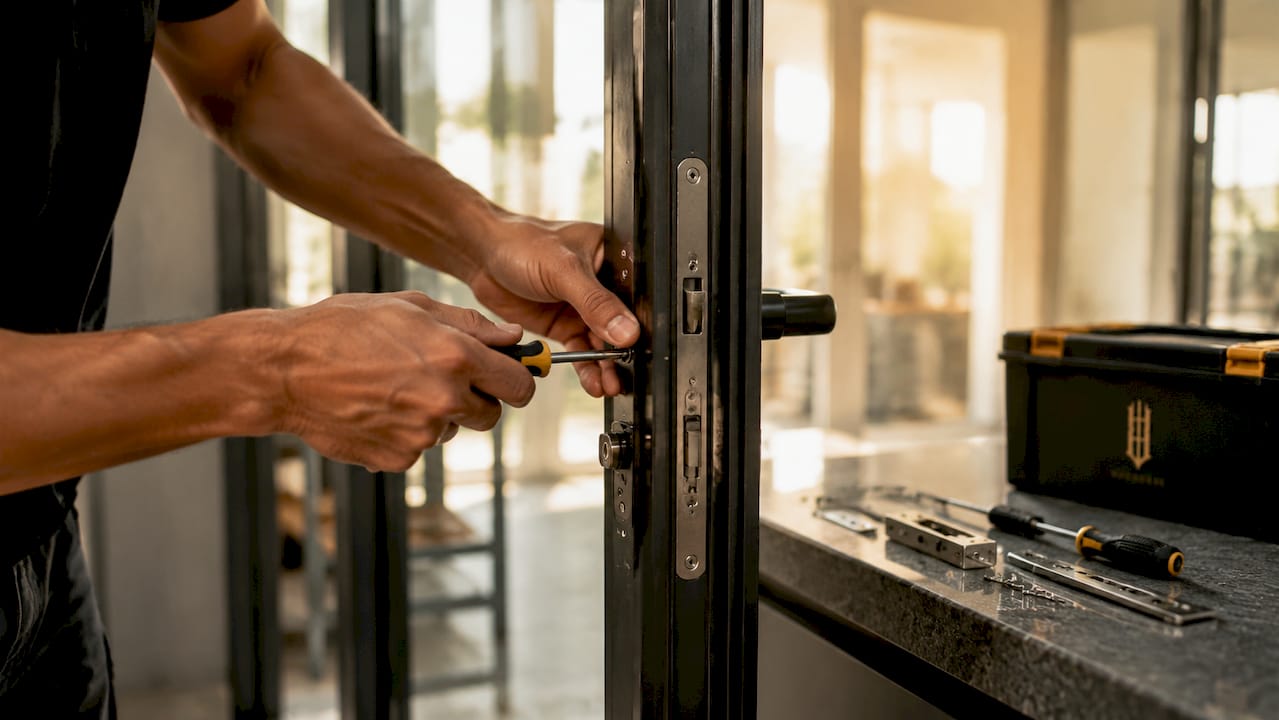
Multipoint locking systems secure the door at three or more points simultaneously by moving hooks, bolts, or rollers through a central gearbox. Lockbox and gearbox quality critically affects smooth operation and long-term durability. Investing in a quality gearbox reduces service calls and operational failures over the door’s lifespan.
For sliding aluminum doors, hookbolt deadlocks and crescent locks are the standard choices. Hookbolt deadlocks offer additional pull-in security for storefront doors, pulling the door tighter into the frame when engaged. This compression effect also improves weathersealing performance.
Key lock types by application:
- Mortise lock: High security, commercial hinged doors
- Rim lock: Surface-mounted, flexible low-traffic use
- Hookbolt deadlock: Sliding and storefront aluminum doors
- Deadlatch: Self-latching, suited for entry doors with automatic closing
- Multipoint lock: Hinged residential and commercial doors requiring maximum forced-entry resistance
Pro Tip: Hinged door locks often feature a 92 mm PZ center, the standard measurement for aluminum profiles. Always verify the PZ center and backset of any lock body against your door stile dimensions before ordering. A backset mismatch causes locking points to miss engagement entirely.
2. which hinge types are best for aluminum doors?
Hinge selection for aluminum doors depends on door weight, stile width, and traffic frequency. Standard residential hinges are inadequate for commercial aluminum doors; heavy-duty butt hinges with ball bearings, continuous piano hinges, or offset pivot hinges are the correct choices for demanding applications.
| Hinge Type | Best Use Case | Installation Difficulty | Relative Cost |
|---|---|---|---|
| Heavy-duty butt hinge (ball bearing) | Standard hinged doors, moderate to heavy traffic | Low | Moderate |
| Continuous piano hinge | Tall or oversized aluminum doors | Moderate | Moderate |
| Offset pivot hinge | Narrow stile, heavy doors | High | High |
| Lift-and-slide hinge | Sliding aluminum door systems | High | High |
| Concealed hinge | Aesthetic-focused residential doors | Moderate | Moderate to High |
Offset pivot hinges transfer door weight directly to the floor and header rather than the frame edges. This makes them the correct choice for narrow stile aluminum doors where frame edge support is insufficient to carry the load. You can explore how Viewluxwindows applies this principle across its pivot door configurations.
Hinges for aluminum doors should be stainless steel or brass, with finishes like brushed nickel or powder coating for weather resistance. In coastal or humid environments, stainless steel is the only reliable long-term choice.
Pro Tip: For tall aluminum doors exceeding 84 inches in height, use a continuous piano hinge rather than three individual butt hinges. The continuous hinge distributes weight evenly across the full door height, preventing warping and reducing stress on the aluminum frame.
3. what handle and hardware designs suit aluminum doors?
Handle selection affects both daily usability and the visual character of the door. The four primary handle types for aluminum doors are lever handles, knob handles, pull handles, and flush handles, each with distinct functional and aesthetic profiles.
Large aluminum doors require scaled pull handles for ergonomic operation, not just aesthetics. A 42-inch grip on a wide entry door is a functional specification, not a design preference. Undersized handles on heavy aluminum doors create usability problems and accelerate wear on the locking mechanism.
Handle type comparison:
- Lever handles: ADA-compliant, easy to operate with one hand, standard for residential and commercial entry doors. Available in 304 and 316 stainless steel, zinc alloy, and anodized aluminum.
- Knob handles: Compact profile, suited to interior aluminum doors with lower traffic. Not ADA-compliant for public spaces.
- Pull handles: Ideal for heavy pivot or swing doors. Sizes range from 12 inches to 48 inches depending on door width and weight.
- Flush handles: Recessed into the door face, used on sliding aluminum doors where a projecting handle would obstruct the track.
Material choices directly affect longevity. 316-grade stainless steel is the highest corrosion-resistant material for hardware and is preferred in high-humidity or coastal environments. Grade 304 stainless steel works well in standard interior and protected exterior applications. Zinc alloy is cost-effective for interior doors but degrades faster in moisture-exposed settings.
Popular finishes include matte black, brushed stainless steel, and PVD (physical vapor deposition) coating. PVD coating bonds at the molecular level and resists scratching and tarnishing far longer than standard paint or plating. For projects where the finish must match across windows and doors, anodized aluminum hardware provides the most consistent color match to the door frame itself.
On smart lock retrofits, many consumer-facing smart locks are not sufficiently secure for storefront aluminum doors. Verify independent testing results against drilling, picking, and kick-in attacks before specifying any smart lock for a commercial aluminum door.
4. aluminum door accessories that enhance security and function
Beyond locks and hinges, a complete aluminum door installation requires several accessories that directly affect security, weatherproofing, and code compliance.
- Door closers: Hydraulic door closers control the speed and force of door closing. Surface-mounted closers are standard for commercial aluminum doors; concealed overhead closers suit high-end residential applications where aesthetics matter.
- Door seals and thresholds: Compression seals along the door perimeter and aluminum or stainless steel thresholds at the base prevent air and water infiltration. These components are critical for energy performance and are required for AAMA-certified door assemblies.
- Strike plates and reinforcement kits: A heavy-duty strike plate anchored with 3-inch screws into the frame significantly increases forced-entry resistance. Reinforcement kits add steel backing to the aluminum frame around the lock area.
- ADA-compliant lock indicators and exit devices: Occupied or vacant indicators on restroom doors and panic exit devices on commercial egress doors are required by code in most jurisdictions. Brands like Von Duprin and Sargent manufacture exit devices rated for aluminum door frames.
- Flush bolts: Used on double-door aluminum configurations to secure the inactive leaf at the top and bottom without a separate lock cylinder.
Pro Tip: When retrofitting hardware on existing aluminum storefront doors, match the legacy footprint specifications. Adams Rite is a common legacy standard for storefront aluminum hardware. Installing a replacement lock with a different footprint requires frame modification, which risks cracking the aluminum extrusion.
5. how to choose the right aluminum door hardware for your project
The correct hardware selection process starts with the door type, then accounts for environment, traffic level, and budget. Matching hardware to usage intensity and environment is critical because commercial-grade hardware differs significantly from residential, especially for safety and ADA compliance.
| Project Type | Recommended Lock | Hinge Type | Handle Material |
|---|---|---|---|
| Residential hinged entry | Multipoint lock, Grade 1 | Heavy-duty butt, ball bearing | 304 stainless steel or anodized aluminum |
| Commercial storefront | Mortise lock or hookbolt deadlock | Heavy-duty butt or continuous | 316 stainless steel |
| Coastal or humid environment | 316 stainless multipoint lock | Stainless steel butt or pivot | 316 stainless steel |
| Sliding patio door | Hookbolt deadlock or crescent lock | Lift-and-slide hardware | Anodized aluminum or 304 stainless |
| Pivot door | Mortise lock with floor pivot | Offset pivot hinge | 316 stainless or PVD-coated pull |
| Bifold aluminum door | Flush bolt and multipoint lock | Folding track hardware | Anodized aluminum flush handle |
For coastal installations, 316 stainless steel is non-negotiable. Salt air degrades zinc alloy and standard 304 stainless steel finishes within two to three years. The additional cost of 316-grade hardware is recovered in reduced replacement and maintenance expenses.
For builders specifying hardware across multiple units, Grade 1 locks (the highest ANSI/BHMA rating) provide the most reliable performance and the longest warranty coverage. Viewluxwindows provides detailed guidance on hardware configurations for different door types in its builder-focused door guide.
Homeowners often underestimate the need to scale hardware proportionally to door size, affecting usability and design coherence. A pull handle that looks proportional in a showroom photo may be undersized on a 10-foot pivot door in person.
Key takeaways
The best aluminum door hardware selection matches lock type, hinge specification, and handle material to the specific door style, environment, and traffic level of the project.
| Point | Details |
|---|---|
| Match lock to door style | Hinged doors need multipoint locks; sliding doors need hookbolt or crescent locks. |
| Prioritize 316 stainless in harsh environments | Coastal and humid installations require 316-grade hardware to prevent corrosion failure. |
| Scale handles to door size | Large aluminum doors need proportionally sized pulls for ergonomic and structural reasons. |
| Verify lock compatibility before ordering | Backset and PZ center must match the door stile profile to avoid operational failure. |
| Use commercial-grade hardware for high traffic | ADA compliance and Grade 1 lock ratings are required for commercial aluminum door installations. |
What working with aluminum door hardware has taught me
The most expensive mistake I see on aluminum door projects is not choosing the wrong finish. It is choosing hardware that was never compatible with the door profile in the first place. A contractor installs a multipoint lock, the locking points miss the strike by 4 millimeters, and the door never locks properly. The fix requires pulling the lock body, reordering, and sometimes reaming the frame. That cost is always higher than the price difference between a compatible and incompatible lock would have been.
The second pattern I see consistently is undersizing hinges on heavy aluminum doors. A 200-pound pivot door with standard butt hinges will sag within a year. The frame distorts, the lock stops engaging cleanly, and the weatherseal compresses unevenly. Offset pivot hinges exist precisely to solve this problem, yet they are still underspecified on residential projects where the budget pressure is highest.
My honest recommendation: spend more on the lock body and the hinges than on the handle finish. The finish is visible. The lock body and hinge are structural. You can upgrade a handle finish later. You cannot easily fix a frame that has been stressed by the wrong hinge for three years. For sliding door projects specifically, the heavy-duty sliding hardware category deserves the same scrutiny as any hinged door assembly. The track, roller, and lock system on a sliding aluminum door are all interdependent. Specifying them together from a single source reduces compatibility risk significantly.
— Liran
Viewluxwindows custom aluminum door hardware solutions
Viewluxwindows designs and supplies aluminum door systems with hardware configurations matched to each project’s specific requirements, from residential pivot entries to large-scale commercial storefronts. Every door goes through a 26-step production process that includes hardware compatibility verification before the unit ships.

Viewluxwindows offers direct-to-consumer pricing that saves clients up to 50% compared to traditional dealers, with NFRC and AAMA certifications backing every assembly. Whether you need 316 stainless multipoint locks for a coastal property or concealed hinges for a high-end residential project, the full range of configurations is available in the Viewluxwindows product catalog. Showrooms are open across California, Colorado, and Nevada. Visit Viewluxwindows to connect with a hardware specialist or request a custom quote.
FAQ
What lock type is standard for aluminum hinged doors?
Multipoint locking systems with a 92 mm PZ center are the standard for aluminum hinged door profiles. They secure the door at three or more points simultaneously, providing significantly better forced-entry resistance than a single-point mortise lock.
Which hinge is best for heavy aluminum doors with narrow stiles?
Offset pivot hinges are the correct choice for narrow stile, heavy aluminum doors. They transfer the door’s weight to the floor and header rather than the frame edges, preventing long-term frame stress and misalignment.
What handle material works best in coastal environments?
316-grade stainless steel is the recommended handle material for coastal and high-humidity environments. It provides the highest corrosion resistance available in standard aluminum door hardware and outlasts zinc alloy or 304 stainless steel in salt-air conditions.
Are smart locks secure enough for aluminum storefront doors?
Many consumer-grade smart locks do not pass independent security tests for drilling, picking, and kick-in resistance. For commercial aluminum storefronts, specify smart locks with verified ANSI/BHMA Grade 1 ratings and independent third-party test results.
What accessories are required for ada-compliant aluminum doors?
ADA-compliant aluminum doors require lever handles (not knobs), a maximum operating force of 5 pounds for interior doors, and panic exit devices on egress doors. Occupied or vacant indicators are required on restroom doors in commercial buildings.


