
A casement window is defined as a window attached to its frame by hinges on the side, top, or bottom, opening outward or inward like a door. Unlike sliding or double-hung windows, casements swing fully open, which gives them a distinct ventilation advantage. They operate through a crank, handle, or lever mechanism and are available in wood, vinyl, and aluminum frames. Homeowners and property developers choose casement windows for their airtight seal, full-sash ventilation, and design flexibility. Understanding the differences between casement types and how they compare to other window styles helps you make a confident purchasing decision.
What is a casement window and how does it work?
A casement window is hinged to its frame and swings open like a door, with hinges placed at the side, top, or bottom of the sash. The term “casement” refers to the frame that holds the glass, and the window is operated by a crank handle, lever, or push bar. Most residential casements use a worm-gear crank mounted at the sill, which gives precise control over how far the window opens. This mechanism also makes casements accessible for homeowners who need to operate windows from a distance, such as above a kitchen counter.
Casement windows are one of the oldest window designs in architectural history, appearing in European buildings long before sliding sash windows became common. The design persists because it solves two problems at once: it seals tightly when closed and opens fully when ventilation is needed. That combination is difficult to achieve with other window types.
What are the main types of casement windows and how do they differ?
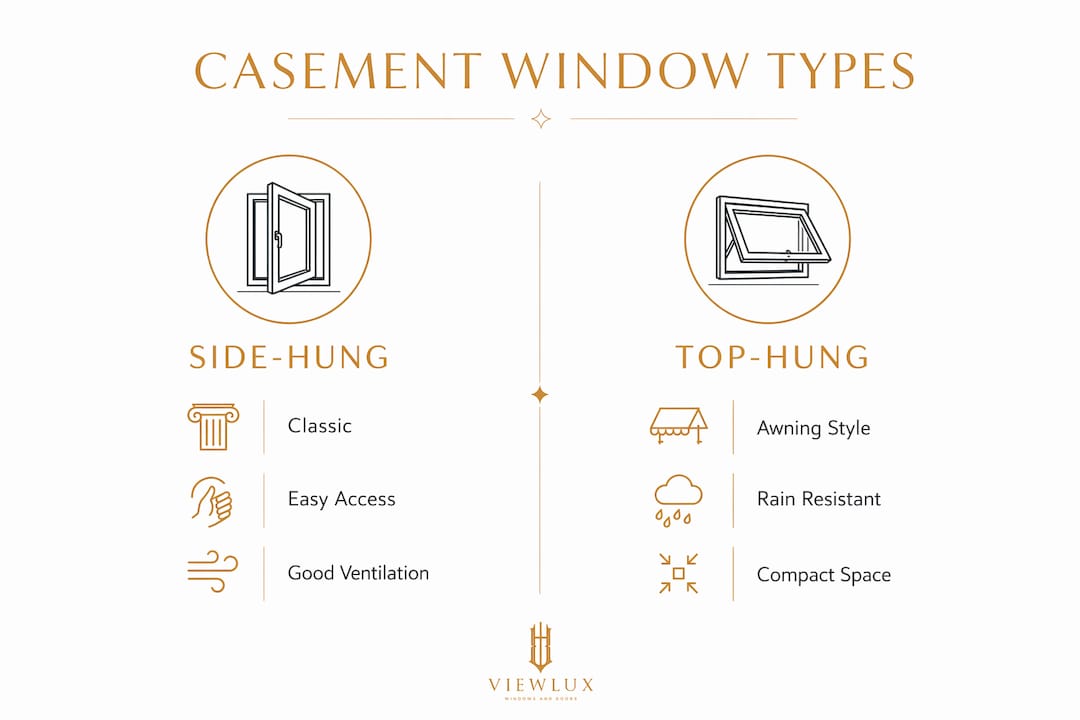
Hinge location changes everything about how a casement window performs. The three primary variants each serve different architectural and functional needs.
- Side-hung casements are the most common type. The sash is hinged on the left or right side and swings outward. This design provides the largest unobstructed opening and suits most living rooms, bedrooms, and kitchens.
- Top-hung (awning) windows are hinged at the top and open outward from the bottom. They allow ventilation even during light rain because the sash acts as a canopy. Awning windows work well in bathrooms, basements, and coastal climates.
- Bottom-hung (hopper) windows are hinged at the bottom and open inward from the top. They are common in tight spaces where an outward swing is blocked by a porch, shrub, or walkway.
- Fixed casements do not open at all. They use the same frame profile as operable casements and are paired with opening units to add light without adding ventilation.
Pro Tip: When combining window types in one wall, pair a side-hung casement with a fixed casement or a transom window to maximize light without sacrificing ventilation control.
The choice between these types affects more than airflow. Top-hung awning windows resist rain intrusion better than side-hung units. Hopper windows direct incoming air downward, which suits basement spaces where ground-level drafts are unwanted. Side-hung units direct air horizontally, which works better in living areas.
What are the functional features and benefits of casement windows?
The most significant benefit of casement windows is ventilation capacity. A fully open casement provides ventilation equal to 100% of its sash area. Sliding windows, by contrast, open to only half their total area because one panel always remains fixed. That difference matters when you need rapid air exchange in a kitchen, bathroom, or bedroom.
Key functional features include:
- Airtight seal: Casement windows close against the frame by pressing the sash directly into the weatherstripping, which produces lower air leakage than sliding windows. This improves thermal comfort and reduces heating and cooling costs.
- Multi-point locking: Most casement hardware locks the sash at multiple points along the frame, not just at a single latch. This makes forced entry significantly harder than with single-latch sliding windows.
- Material flexibility: Casement frames are available in wood, vinyl, fiberglass, and aluminum. Aluminum frames, in particular, offer a slim profile that maximizes glass area while maintaining structural strength.
- Automation compatibility: Casement windows can be fitted with motorized actuators, making them suitable for high or hard-to-reach installations in commercial and residential buildings.
- Design versatility: Casements work in traditional, transitional, and modern architectural styles. Their clean sightlines and minimal frame profiles suit contemporary designs especially well.
Pro Tip: For maximum energy performance, pair a casement window with low-E glazing options and thermally broken aluminum frames. This combination delivers strong thermal resistance without sacrificing the slim profile that makes casements visually appealing.
Casement windows also support indoor air quality. Because they open fully, they can flush a room with fresh air quickly. Building regulations in many jurisdictions require “purge ventilation,” which means the ability to rapidly exchange stale air. Open casement windows satisfy purge ventilation requirements, while trickle vents handle background ventilation when windows are closed.
Casement window vs sash window: which performs better?
The casement vs sash window comparison comes down to three factors: ventilation, energy efficiency, and maintenance.
| Feature | Casement window | Sash window |
|---|---|---|
| Opening mechanism | Hinged, swings open | Slides vertically or horizontally |
| Maximum ventilation area | 100% of sash area | Up to 50% of sash area |
| Airtightness | High, sash presses against frame | Moderate, sliding seals wear faster |
| Ease of cleaning | Sash tilts or swings for access | Requires reaching through or removing sash |
| Architectural style | Modern, transitional, traditional | Traditional, period, heritage |
| Weather resistance | Excellent when closed | Good, but sliding seals degrade faster |
Casement windows offer more ventilation and better airtightness than sash windows, which slide vertically and cannot open fully. Sash windows, however, remain the correct choice for heritage buildings and period-style homes where architectural authenticity is required. A Georgian townhouse or Victorian terrace looks wrong with casements. A contemporary home or new build looks sharp with them.
Maintenance differences are also real. Sash windows have more moving parts, including cords, pulleys, or spiral balances, that wear over time. Casement hinges and crank mechanisms are simpler and easier to replace. Cleaning is also easier with casements because the sash swings outward, giving access to the exterior glass from inside the building.
What practical factors should homeowners consider when choosing casement windows?
Selecting the right casement window requires more than picking a style. Placement, swing direction, and regulatory compliance all affect long-term satisfaction.
-
Determine swing direction early. Outward-swinging casements provide maximum ventilation but require clear exterior space. A window above a patio table, walkway, or dense shrub needs an inward-swinging hopper or a top-hung awning unit instead. Hinge direction affects furniture placement inside and landscaping decisions outside.
-
Check clearance requirements. Outward casements need at least the full width of the sash as clear exterior space. Inward-swinging hoppers need interior clearance, which can conflict with furniture, blinds, or curtain rods placed close to the window.
-
Plan your window combinations. Single casements, paired casements, and casements with transoms each create different light and ventilation profiles. A paired casement with a fixed transom above it brings in more light than a single unit while keeping the operable area manageable.
-
Choose the right frame material. Wood frames offer warmth and traditional aesthetics but require periodic painting or staining. Vinyl frames are low maintenance but have limited color options and thicker profiles. Aluminum frames deliver the slimmest sightlines and the longest service life, making them the preferred choice for modern architectural designs and commercial projects.
-
Verify ventilation compliance. Building codes in most U.S. jurisdictions require habitable rooms to have openable windows that meet minimum ventilation area ratios. Casement windows typically satisfy these requirements more easily than sliding windows because of their full-sash opening. Check local codes before finalizing window sizes, particularly for bedrooms, which also have egress requirements.
-
Consider hardware quality. The crank mechanism and hinges on a casement window take more mechanical stress than a simple sliding latch. Specify quality aluminum hardware with corrosion-resistant finishes, especially in coastal or high-humidity environments.
For new construction projects, the choice between retrofit and new-construction window frames also affects installation cost and performance. A 2026 retrofit vs. new construction guide covers the frame differences in detail and helps developers select the right installation method for each project type.
Key takeaways
Casement windows outperform sliding and sash windows on ventilation and airtightness, making them the strongest choice for energy-conscious homeowners and modern new builds.
| Point | Details |
|---|---|
| Definition and mechanism | Casement windows are hinged windows that open like a door, operated by a crank or handle. |
| Three main types | Side-hung, top-hung (awning), and bottom-hung (hopper) each serve different spaces and climates. |
| Ventilation advantage | A fully open casement provides 100% of its sash area as ventilation, double what sliding windows offer. |
| Energy efficiency | The sash-to-frame seal on casements produces lower air leakage than sliding window designs. |
| Practical selection factors | Swing direction, clearance, frame material, and local ventilation codes all affect the right choice. |
Why I think most homeowners underestimate hinge direction
After working with window installations across a wide range of home types, the single most overlooked detail is swing direction. Homeowners spend time choosing frame color and glazing type, then discover after installation that the window swings into a curtain rod, a piece of furniture, or a porch column.
The fix is simple but requires thinking about it before the window is ordered. Walk the exterior of the building and note every obstruction within the swing radius of each proposed window. Do the same inside. A hopper window in a basement bathroom costs the same as a side-hung casement but avoids the problem entirely when exterior clearance is limited.
My other consistent observation is that people underestimate how much the frame material affects long-term satisfaction. Vinyl frames look fine at installation. Five years later, the limited color options and thicker profiles start to feel dated, especially on modern homes. Aluminum frames hold their appearance longer, accept custom colors, and maintain tighter tolerances over time. The upfront cost difference is real, but the long-term value is clear.
Finally, do not skip the hardware specification. A casement window is only as reliable as its crank mechanism and hinges. Specify hardware with a corrosion-resistant finish from the start, not as an afterthought. Replacing a failed crank on an installed window is a frustrating and avoidable repair.
— Liran
Viewluxwindows casement window solutions for homeowners and developers
Viewluxwindows designs and manufactures custom aluminum casement windows for homeowners, architects, and builders across California, Colorado, and Nevada. Every unit goes through a 26-step production process and carries NFRC and AAMA certifications, which verify energy performance and structural durability independently.

Viewluxwindows sells direct to consumers, which removes dealer markups and delivers savings of up to 50% compared to traditional distribution channels. The product line covers side-hung, awning, and fixed casement configurations, with options for energy-efficient glazing including low-E coatings and thermally broken frames. Homeowners researching whether premium windows increase property value will find that certified, well-specified casements consistently rank among the highest-return window investments. Visit a Viewluxwindows showroom or browse the full product range to find the right casement configuration for your project.
FAQ
What is a casement window in simple terms?
A casement window is a window hinged to its frame that swings open like a door, operated by a crank or handle. Hinges can be on the side, top, or bottom of the sash.
Are casement windows more energy efficient than sliding windows?
Yes. Casement windows press the sash directly against the frame when closed, producing lower air leakage than sliding windows, which rely on sliding seals that wear over time.
What is the difference between an awning and a casement window?
An awning window is a type of casement window hinged at the top that opens outward from the bottom. A standard casement is typically side-hinged and swings left or right.
Can casement windows meet building ventilation requirements?
Yes. Open casement windows satisfy purge ventilation requirements in most building codes because they provide ventilation equal to 100% of the sash area. Trickle vents handle background ventilation when the window is closed.
What frame material is best for casement windows?
Aluminum is the best frame material for modern casement windows. It delivers the slimmest sightlines, the longest service life, and accepts custom colors, making it the preferred choice for contemporary residential and commercial projects.
Recommended
- Casement – ViewLux Windows And Doors, Inc.
- Aluminum Window Installation Sequence: 2026 Builder Guide – ViewLux Windows And Doors, Inc.
- Energy Efficient Window Glazing Options for Homes – ViewLux Windows And Doors, Inc.
- Retrofit vs. New Construction Window Frames: 2026 Guide – ViewLux Windows And Doors, Inc.


