
A lift and slide door is a sliding door system where the panel physically lifts off its compression seals when you turn the handle, glides on low-friction rollers, then drops back down to create a full-perimeter airtight seal when closed. This mechanism is fundamentally different from a standard sliding door, which drags its seals during every operation. The result is a door that handles panels up to 900 lbs and up to 12 feet tall with effortless movement and superior thermal performance. For homeowners and interior designers pursuing large glass openings and modern indoor-outdoor living, this system sets the standard.
How do lift and slide doors work?
The lift and slide mechanism operates in three distinct phases. Understanding each phase explains why this system outperforms traditional sliding doors in both feel and longevity.
-
Handle rotation. Turning the handle activates a multi-point hardware mechanism inside the door frame. This causes the panel to lift several millimeters off its compression gaskets and onto a set of low-friction rollers embedded in the track.
-
Sliding. With the panel riding on rollers and completely clear of the seals, it glides along the track with minimal effort. A panel weighing 600 lbs moves with the same ease as a much lighter door because the rollers carry the load.
-
Lowering and seal compression. When the panel reaches its closed position, reversing the handle drops it back down. The panel’s full weight compresses the gaskets around the entire perimeter, creating a tight seal against air, water, and sound.
Engineers emphasize that lift and slide systems are not simply heavier sliding doors. The mechanism preserves gasket life by eliminating friction during operation entirely. A standard sliding door drags its brush or pile seals every time it moves, wearing them down over years of use. A lift and slide door never touches its seals until it is fully closed. That single design difference accounts for a significant gap in long-term airtightness and maintenance costs.
Pro Tip: When testing a lift and slide door in a showroom, pay attention to the handle action. A quality system should require only a quarter turn to lift the panel. If the handle feels stiff or the panel drags, the hardware tolerances are off.

The aluminum door hardware used in premium systems includes precision-machined rollers, multi-point locking bars, and stainless steel components rated for coastal exposure. The quality of this hardware directly determines how smoothly the door operates after ten years of daily use.
What are the key benefits of lift and slide doors?
Lift and slide doors deliver advantages across four areas that matter most to homeowners and designers: spatial design, energy performance, security, and weather resistance.
-
Expansive glass openings. The system supports panels up to 12 feet tall and weighing up to 900 lbs per panel. That capacity allows architects to specify glass walls rather than doors, creating the “disappearing wall” effect that defines contemporary residential design.
-
Indoor-outdoor flow. Residential designers use lift and slide systems to transform enclosed rooms into semi-outdoor environments. Minimal frame sightlines and floor-to-ceiling glass maximize natural light and eliminate the visual boundary between interior and exterior spaces.
-
Superior airtightness and energy efficiency. The compression seal engages only when the door is fully closed, producing a full-perimeter gasket contact that standard sliding doors cannot replicate. This directly reduces heating and cooling loads, which matters in both cold climates and hot desert regions.
-
Enhanced security. Premium lift and slide doors integrate strong locking mechanisms combined with compression seals. The locking system engages with the compression, making the closed panel highly resistant to forced entry compared to typical sliding door models.
-
Weather resistance in exposed locations. The airtight compression seal prevents driving wind and rain penetration. This makes lift and slide systems the preferred choice for coastal or high-exposure locations where standard brush-sealed doors fail over time.
“Lift and slide doors change the fundamental relationship between a room and the outdoors. When the panel slides away, the living space expands. When it closes, the room becomes a sealed, thermally efficient envelope. No other single-panel door system achieves both at this scale.”
The property value impact is also measurable. Premium windows and doors consistently rank among the highest-return upgrades in upscale residential projects, and lift and slide systems are a primary driver of that return.
Lift slide door vs folding door: which is right for your project?
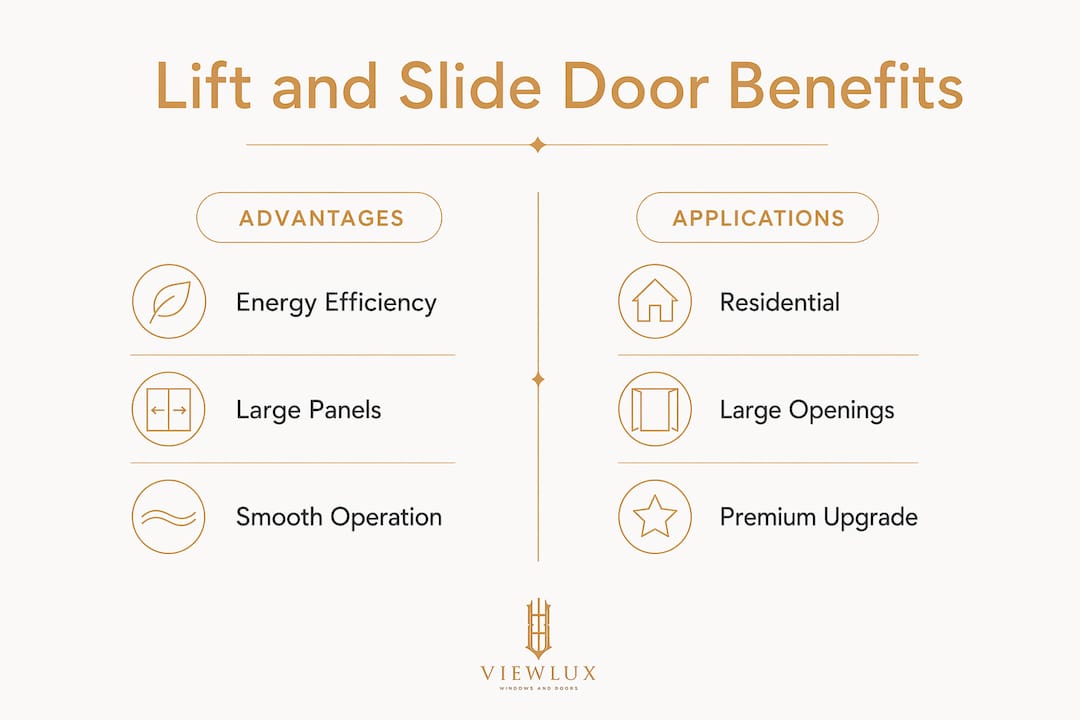
Homeowners frequently compare lift and slide systems against folding doors and standard sliding doors when planning large openings. Each system has a distinct profile of strengths and trade-offs.
| Feature | Lift and slide door | Folding door | Standard sliding door |
|---|---|---|---|
| Panel weight capacity | Up to 900 lbs per panel | Typically lower per panel | Lower, limited by seal drag |
| Seal type | Full-perimeter compression | Varies; often brush or pile | Brush or pile seal |
| Weather resistance | Excellent; airtight when closed | Good; varies by design | Moderate |
| Opening width | Wide; panels stack to one side | Very wide; panels fold flat | Wide; panels stack to side |
| Operation ease | Single handle lifts and glides | Multiple panels fold in sequence | Direct push or pull |
| Security | High; compression locking | Moderate to high | Moderate |
| Maintenance | Low; seals preserved during use | Moderate; multiple hinges | Higher; seal wear over time |
| Best application | Large single or paired panels | Maximum open-wall effect | Budget-conscious projects |
Compared to folding doors, lift and slide systems offer easier single-panel operation with better sealing and support for heavier, larger panels. Folding doors create a wider clear opening when fully stacked, which suits projects where a completely unobstructed threshold is the priority. Lift and slide doors suit projects where a large glass panel needs to disappear to one side while maintaining a clean, minimal frame profile.
Standard sliding doors remain a cost-effective option for smaller openings, but their brush seals wear with use and their panel weight limits restrict glass size. For any opening wider than 8 feet or taller than 8 feet, a lift and slide system is the technically superior choice. The bifold vs sliding door comparison covers these trade-offs in greater detail for homeowners weighing all options.
What to know about lift and slide door installation and maintenance
Installation of a lift and slide system requires more precision than a standard sliding door. The track must be perfectly level across its full length. Even a small deviation causes the panel to drift or bind during operation. Structural rough openings also need to accommodate the additional frame depth required by the lift mechanism hardware.
Key installation and maintenance considerations include:
- Structural support. Panels weighing 600–900 lbs require a reinforced header and a floor track anchored to a solid substrate. Concrete or steel-reinforced slab installations are ideal.
- Track alignment. The installer must verify track levelness with a precision level across the full span before setting the panel. Post-installation adjustment is difficult once the frame is set.
- Climate compatibility. The compression seal performs well in all climates. In coastal environments, specify hardware with a marine-grade finish to prevent corrosion on exposed metal components.
- Routine maintenance. Clean the track channel every three to six months to remove debris that can interfere with roller movement. Lubricate the rollers and hardware with a silicone-based product annually.
- Gasket inspection. Inspect compression gaskets yearly for signs of compression set or cracking. Replacing gaskets proactively costs far less than addressing air or water infiltration after failure.
Lift and slide doors carry a cost premium over standard sliding doors. That premium is justified by enhanced sealing, larger size capacity, and architectural appeal. For upscale residential projects, the lifecycle cost calculation favors lift and slide systems because lower maintenance frequency and better energy performance offset the higher purchase price over time.
Pro Tip: Request that your installer provide a written track levelness certification before the panel is set. This single step prevents the most common post-installation complaints: panel drift, difficult operation, and seal gaps.
The custom aluminum door configurations available from premium manufacturers allow homeowners to specify exact panel dimensions, glazing type, and hardware finish before fabrication, which eliminates costly field modifications during installation.
Key Takeaways
A lift and slide door outperforms standard sliding doors because its compression seal engages only when closed, preserving gasket life and delivering airtight thermal performance at panel sizes up to 900 lbs and 12 feet tall.
| Point | Details |
|---|---|
| Mechanism is unique | The panel lifts off seals onto rollers to slide, then drops to compress gaskets when closed. |
| Seal wear is eliminated | Zero friction against gaskets during operation extends airtight performance over the door’s lifespan. |
| Size capacity is exceptional | Panels up to 900 lbs and 12 feet tall are supported, enabling true glass-wall architectural designs. |
| Weather and security performance | Compression locking and full-perimeter seals make these doors ideal for coastal and high-exposure sites. |
| Installation precision matters | Track levelness and structural support are critical; errors at installation cause long-term operational problems. |
Why lift and slide doors are redefining residential architecture
I have worked with homeowners and designers on window and door specifications for years, and the shift toward lift and slide systems is one of the clearest trends I have seen. The reason is not purely aesthetic. Clients who install these doors report a change in how they actually use their homes. A living room that opens fully to a terrace gets used differently than one separated by a fixed wall of glass. The door stops being a boundary and becomes a choice.
What surprises most homeowners is how the compression seal changes the closed-door experience. A room with a lift and slide door closed feels quieter and more thermally stable than the same room with a standard sliding door. That is not a subtle difference. On a windy night or a hot afternoon, the gap in performance is obvious.
The one thing I consistently tell designers: do not underestimate the weatherproofing benefit, especially in California coastal projects or high-desert locations in Colorado and Nevada. Clients often focus on the glass size and the aesthetics. The compression seal is what makes the system perform year after year in those environments. Specify the right hardware finish for the exposure level, and this door will outlast almost everything else in the house.
— Liran
Viewluxwindows lift and slide door solutions

Viewluxwindows designs and manufactures premium aluminum lift and slide door systems with NFRC and AAMA certifications, built for modern residential architecture across California, Colorado, and Nevada. Every system goes through a 26-step production process and ships direct to the homeowner or builder, cutting costs by up to 50% compared to traditional dealer pricing. Custom panel dimensions, energy-efficient glazing options, and marine-grade hardware finishes are available for any project specification. Pair a lift and slide system with one of the upscale residential window packages to complete a cohesive, high-performance building envelope. Contact Viewluxwindows to request a custom configuration quote or visit a showroom in your region.
FAQ
What is a lift and slide door?
A lift and slide door is a sliding door system where turning the handle lifts the panel off its compression seals onto low-friction rollers for smooth operation, then drops it back to create a full-perimeter airtight seal when closed.
How heavy can a lift and slide door panel be?
Lift and slide door panels can weigh up to 900 lbs per panel and reach up to 12 feet in height, making them suitable for large architectural glass openings.
Are lift and slide doors more energy-efficient than standard sliding doors?
Yes. The compression seal engages fully around the entire perimeter when the door is closed, providing superior airtightness that standard brush-sealed sliding doors cannot match.
How do lift and slide doors compare to folding doors?
Lift and slide systems offer easier single-panel operation, better sealing, and support for heavier panels. Folding doors create a wider clear opening when fully stacked but involve more moving parts and maintenance points.
How often do lift and slide doors need maintenance?
Track cleaning every three to six months, annual roller lubrication with a silicone-based product, and yearly gasket inspection keep a lift and slide door operating correctly with minimal effort.
Recommended
- What Is a Sliding Pocket Door: Homeowner’s Guide – ViewLux Windows And Doors, Inc.
- What Is a Casement Window? A Homeowner’s Guide – ViewLux Windows And Doors, Inc.
- Heavy-Duty Sliding – ViewLux Windows And Doors, Inc.
- Aluminum Door Threshold Detail Guide for Builders – ViewLux Windows And Doors, Inc.


