
A value-engineering window is a window specified or redesigned through a systematic VE process to deliver required functions — comfort, daylight, thermal control, durability — at the lowest life-cycle cost, not simply the lowest upfront price. The formal definition, codified in OMB Circular A-131, expresses value as function divided by cost: raise the function, lower the cost, or both, and you increase value. For architects, builders, and homeowners, understanding value engineering windows means knowing which performance levers to pull and which shortcuts to avoid.
Standards bodies like NFRC, AAMA, and WDMA provide the measurement framework that makes those decisions defensible. Manufacturers like Viewluxwindows, with NFRC and AAMA certifications and a factory-direct production model, are the suppliers who can actually deliver on a VE recommendation without inflating the budget.
The core tradeoffs a window VE process typically balances:
- Upfront cost vs. life-cycle cost: Lower purchase price often raises energy and maintenance costs over the building’s expected life cycle.
- Thermal performance vs. glazing cost: Higher-performance low-E coatings and thermally broken frames cost more initially but reduce HVAC loads.
- Daylight vs. solar control: Maximizing visible transmittance (VT) and managing solar heat gain coefficient (SHGC) pull in opposite directions on tinted or coated glass.
- Fabrication simplicity vs. design intent: Standard sizes reduce production cost but may require field modifications that introduce thermal bridging or air-sealing risk.
Table of Contents
- What value engineering actually means for windows and doors
- How the six-phase VE process maps to window decisions
- Concrete VE levers for windows and what each one costs you
- When to run VE for windows and who belongs on the team
- How to evaluate VE options: metrics and life-cycle cost
- Common mistakes and red flags when value-engineering windows
- A step-by-step checklist for your window VE workshop
- How Viewluxwindows applied VE on a modern residential project
- Key Takeaways
- Why VE, done well, protects design quality
- Viewluxwindows makes VE-ready window packages accessible
- Useful sources for window VE work
What value engineering actually means for windows and doors
Value engineering is a systematic, multidisciplinary, function-focused process that optimizes life-cycle cost while meeting performance, quality, and safety requirements. That definition comes directly from OMB Circular A-131 and from the WBDG guidance on VE. What it is not: indiscriminate scope reduction that sacrifices the functions a window must perform.

The distinction matters because “value engineering” is frequently misused on job sites as a polite term for cutting specification. Removing insulating glazing to save $8 per square foot is cost-cutting. Selecting a different glazing stack that achieves the same U-factor at a lower fabrication cost is VE. The first approach compromises function; the second preserves it.
Three standards bodies define the measurement framework that keeps VE decisions honest:
- NFRC (National Fenestration Rating Council) provides certified ratings for U-factor, SHGC, VT, and condensation resistance. These ratings are the baseline any VE comparison must start from.
- AAMA (American Architectural Manufacturers Association) sets performance classes and test protocols for structural load, air infiltration, and water resistance. AAMA class determines whether a window survives the climate it is installed in.
- WDMA (Window and Door Manufacturers Association) publishes industry standards for manufacturing quality and performance grading, complementing AAMA testing with product-level benchmarks.
A VE proposal that lacks NFRC and AAMA data is not a VE proposal. It is a price reduction with unquantified consequences.
Wrong approach: Remove the insulating glazing unit and substitute single-pane glass to save cost.
VE approach: Switch from a standard double-pane unit to a high-performance low-E double-pane with a warm-edge spacer, achieving a lower U-factor at comparable or reduced cost through factory-direct sourcing.
How the six-phase VE process maps to window decisions
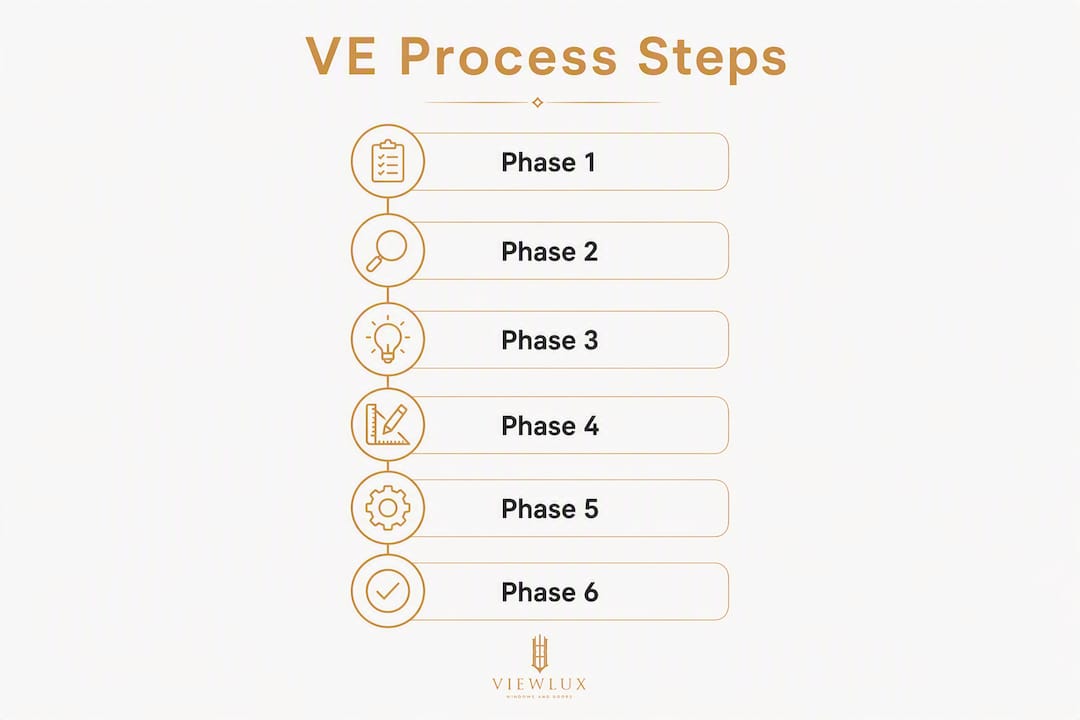
The standard VE job plan follows six structured phases. Each phase has a direct window-specific application.
- Function Analysis — Identify what each window must do. Required functions typically include daylighting, solar control, operability, structural resistance, air-sealing, and security. Assign a relative importance to each so the team knows which functions cannot be traded away.
The table below maps common window functions to the VE questions and levers each phase should address.
| Window Function | Key VE Question | Candidate Levers |
|---|---|---|
| Daylighting | Is VT adequate for the space program? | Glazing coating selection, tint level, unit size |
| Thermal control | Does the U-factor meet energy code? | Low-E coating, gas fill, thermally broken frame |
| Solar control | Is SHGC appropriate for orientation? | Coating type, external shading, glazing tint |
| Ventilation | Is operable area sufficient? | Casement vs. fixed ratio, hardware selection |
| Durability | Does AAMA class match climate exposure? | Frame material, finish, hardware grade |
| Fabrication cost | Can standard sizes reduce production cost? | Unitization, modular grid, factory glazing |
Pro Tip: Run VE during schematic design or before the 35% construction document milestone. The WBDG guidance confirms that earlier interventions reduce change orders and improve alignment between design intent and cost reality. A VE workshop after construction documents are complete still has value, but the savings potential is significantly lower.
Concrete VE levers for windows and what each one costs you
Each lever below changes cost, performance, or both. The tradeoffs are real and should be quantified before any change is approved.
-
Unitization and standard sizes. Modular, factory-assembled units reduce fabrication labor and field installation time. The tradeoff: standard sizes may not align with the architectural grid, requiring field cutting or custom rough openings that introduce thermal bridging risk. Reviewing custom vs. standard sizing cost differences before committing to a grid helps avoid that surprise.
-
Frame material and thermal break. Aluminum frames without a thermal break are the lowest-cost option but perform poorly in cold climates. Thermally broken aluminum systems add cost upfront and substantially lower the U-factor, reducing HVAC load over the building’s life. The aluminum window thermal performance guide provides frame-level U-factor comparisons useful in VE evaluation.
-
Glazing stack changes. Switching from a standard double-pane unit to a high-performance low-E configuration raises purchase price but lowers SHGC and U-factor. Energy-efficient glazing options — including coatings, gas fills, and warm-edge spacers — each affect U-factor, SHGC, and VT differently and should be modeled before selection.
-
Spacer and gas fill. Argon or krypton fill improves U-factor modestly at low added cost. Warm-edge spacers reduce condensation risk and edge-of-glass heat loss. Both are low-cost VE upgrades with measurable lifecycle returns.
-
VT vs. SHGC tradeoff. FacilitiesNet’s guidance on window VE warns that over-tinting glass to reduce SHGC kills daylighting, which increases artificial lighting loads and can offset the solar gain savings entirely. Specify by orientation: south-facing glazing needs low SHGC; north-facing glazing needs high VT.
-
Hardware simplification. Reducing hardware complexity lowers unit cost but can compromise operability, egress compliance, or long-term durability. Multipoint locking systems cost more than single-point hardware and deliver better air-sealing and security. Dropping them to save cost is a function reduction, not VE.
-
Factory glazing vs. field glazing. Factory-glazed units offer tighter quality control, better air-sealing consistency, and reduced field labor. Field glazing is more flexible for sequencing but introduces more variability. For large projects, factory glazing typically reduces total installed cost when transport and handling logistics are planned early.
-
Installation details and air-sealing. Poor installation coordination is the most common source of post-occupancy complaints on value-engineered window packages. Sill flashing, head flashing, and continuous air barrier connections must be detailed in the VE proposal, not left to field judgment.
-
Warranty and maintenance. Dropping from a 10-year to a 5-year finish warranty saves nothing if the finish fails at year 6. Require warranty documentation in every VE proposal and compare total cost of ownership, not just purchase price.
Pro Tip: When evaluating glazing changes, always model the HVAC impact alongside the window cost delta. A higher-performance low-E unit that reduces cooling load may allow a smaller mechanical system, generating savings that dwarf the glazing premium.

When to run VE for windows and who belongs on the team
The highest-value window VE happens at two project stages: concept/schematic design and before final construction documents. At schematic design, the team can still change unit sizes, frame systems, and glazing specifications without triggering drawing revisions across multiple disciplines. Before final CDs, there is still time to update the energy model and coordinate with the mechanical engineer on HVAC sizing.
Later-stage VE is still possible through value engineering change proposals (VECPs) during construction, but the savings potential is lower and the coordination burden is higher. For smaller residential projects, including accessory dwelling units, ADU-specific VE guidance offers a useful framework for owners who want to apply VE principles without a full consultant team.
The recommended team for a window VE workshop:
- Architect — holds design intent, confirms which functions are non-negotiable
- Facade engineer or thermal specialist — runs U-factor and SHGC modeling, validates energy code compliance
- General contractor or installer — assesses constructability, field sequencing, and installation risk
- Window supplier or manufacturer representative — provides cost data, lead times, and unitization options
- Owner or operations representative — sets lifecycle and maintenance priorities
- Independent VE facilitator (recommended for projects above a certain complexity threshold) — keeps the process function-first and prevents the session from becoming a price negotiation
A typical window VE workshop runs one to two days and produces VE proposals with cost deltas, energy deltas, and a recommended implementation path. OMB Circular A-131 confirms that multidisciplinary teams with experienced facilitators consistently identify cost improvements that single-discipline reviews miss.
How to evaluate VE options: metrics and life-cycle cost
Every VE proposal for windows should be scored against the same set of metrics. Comparing options on purchase price alone is the most common evaluation error.
| Metric | What It Measures | Why It Matters in VE |
|---|---|---|
| U-factor | Thermal transmittance (lower = better insulation) | Drives heating and cooling energy cost |
| SHGC | Solar heat gain coefficient (lower = less solar gain) | Affects cooling load and comfort by orientation |
| VT | Visible transmittance (higher = more daylight) | Affects artificial lighting load and occupant comfort |
| Air leakage | Infiltration rate at standard pressure | Affects heating/cooling energy and moisture risk |
| Maintenance cost | Annual upkeep, finish durability, hardware replacement | Affects 20 year total cost of ownership |
| Warranty duration | Coverage period for product and finish | Proxy for manufacturer confidence in durability |
| Embodied carbon | Carbon in materials and manufacturing | Optional but increasingly required on green projects |
For life-cycle cost comparison, the basic formula is:
Life-cycle cost = Initial cost + Present value of (annual energy cost × years) + Present value of (annual maintenance cost × years)
A practical evaluation line item should show: delta in upfront cost, delta in annual energy cost, delta in annual maintenance cost, and net present cost over the analysis period (typically over a multi-decade horizon). Tools like EnergyPlus, or energy-modeling plugins within standard BIM workflows, can quantify the energy delta. NFRC label lookups provide the certified performance inputs those models require.
Autodesk’s VE guidance makes the point clearly: VE can justify higher initial expenditures when the life-cycle math supports it. A window that costs more to purchase but reduces annual energy spend and requires no finish maintenance for 15 years is the higher-value product, not the lower-value one.
Common mistakes and red flags when value-engineering windows
Most window VE failures follow a predictable pattern: a single-discipline cost review that ignores performance consequences.
Mistakes to avoid:
- Removing insulating glazing to reduce unit cost. This raises U-factor, increases heating and cooling loads, and often triggers HVAC resizing that costs more than the glazing savings.
- Over-tinting glass to reduce SHGC. As FacilitiesNet documents, excessive tinting kills VT, raises artificial lighting loads, and can produce net-negative energy outcomes.
- Simplifying hardware below the required performance class. Egress hardware, multipoint locks, and heavy-duty hinges are not optional on operable units in high-wind or high-security applications.
- Ignoring installation and air-sealing details. A high-performance window installed with gaps in the air barrier performs no better than a standard unit. Installation coordination must be part of every VE proposal.
- Dropping warranties to shave price. A shorter or narrower warranty shifts risk to the owner. Require full warranty documentation before approving any VE change.
- Using poor sizing assumptions. Undersized rough openings or non-modular unit dimensions cause field rework that erases fabrication savings.
Red flags in a VE proposal — reject or require revision if you see:
- No NFRC-certified performance data for the proposed alternative
- No AAMA performance class designation
- Missing life-cycle cost calculation (purchase price only)
- Unclear or excluded warranty terms
- Single-discipline recommendation with no thermal or daylight review
- No documentation of installation tolerances or air-sealing requirements
A cautionary pattern seen on large glazed projects: teams reduce glazing performance to cut facade cost, then discover at commissioning that the HVAC system is undersized for the actual solar gain. The mechanical redesign and equipment upgrade cost more than the original glazing premium. Require a whole-envelope review before approving any glazing change.
A step-by-step checklist for your window VE workshop
Use this sequence to structure a window VE workshop or to evaluate a supplier’s VE proposal.
- Prepare the baseline. Assemble the current window schedule, NFRC ratings, AAMA performance class, energy model inputs, and unit costs.
- Gather NFRC and AAMA data for all candidate alternatives. No data, no evaluation.
- Run function analysis. List required functions (daylighting, thermal control, operability, security, durability) and rank them by project priority.
- Generate 5–8 candidate alternatives. Cover glazing changes, frame options, unitization strategies, hardware grades, and installation methods.
- Run quick life-cycle estimates. For each candidate, calculate delta in upfront cost, delta in annual energy, and delta in maintenance over 20 years.
- Select 1–2 options that improve value (function/cost ratio) without compromising required functions.
- Develop implementation drawings and O&M notes. Include revised specs, installation details, air-sealing requirements, and warranty summary.
- Document decision rationale. Produce a one-page VE summary with quantified deltas for owner sign-off.
Questions to ask suppliers during VE meetings or in RFPs:
- What are the lead times for standard vs. custom unit sizes?
- What does the warranty cover, and what does it exclude?
- Can you provide NFRC test reports and AAMA performance class documentation?
- What are the installation tolerances, and what air-sealing details do you recommend?
- What are the tradeoffs between factory glazing and field glazing for this project scale?
- Can you provide unitization options and modular grid recommendations?
- Do you offer energy-performance modeling support or thermal calculation summaries?
Require a one-page VE summary with quantified deltas before any change is approved. Verbal commitments on cost savings are not a VE deliverable.
How Viewluxwindows applied VE on a modern residential project
A recent residential project illustrates how VE works in practice. The owner wanted expansive views with strong thermal control in a climate with significant cooling loads. The baseline specification called for large fixed and operable aluminum units with standard double-pane glazing, sized to the architectural grid but not optimized for fabrication efficiency.
The VE opportunity identified during schematic design:
- Unit sizes varied across the facade with no modular coordination, driving up fabrication cost.
- The glazing stack met minimum energy code but left SHGC higher than the orientation warranted.
- Hardware was specified at a premium grade across all units, including fixed lites that require no hardware beyond glazing beads.
The selected VE solution:
- Rationalized the unit grid to a modular system, reducing the number of unique unit sizes and lowering fabrication cost.
- Upgraded the glazing stack to a high-performance low-E configuration with a warm-edge spacer, improving U-factor and reducing SHGC on south and west elevations without sacrificing VT on north-facing units.
- Specified premium hardware only on operable units; fixed lites received standard glazing bead details.
Before/after outcomes:
- U-factor improved on the upgraded glazing units, reducing the calculated cooling load.
- SHGC on south and west elevations dropped, allowing the mechanical engineer to reduce cooling capacity.
- Fabrication cost on the rationalized unit grid offset the glazing upgrade premium, producing a net reduction in total window package cost.
- Lead time shortened because fewer unique unit sizes required less custom tooling.
Viewluxwindows’s factory-direct production model, NFRC and AAMA certifications, and 26-step production process supported this outcome. Factory glazing reduced field installation variability, and the direct-to-manufacturer relationship eliminated dealer markup, keeping the upgraded glazing specification within budget. The brand’s custom aluminum systems, available across California, Colorado, and Nevada showrooms, are designed precisely for this kind of specification-level VE work.
Key Takeaways
Value engineering for windows delivers the best outcomes when it starts early, uses certified performance data, and evaluates life-cycle cost rather than purchase price alone.
| Point | Details |
|---|---|
| VE is function-first | Define required functions before generating alternatives; never trade away a required function for cost savings. |
| Run VE early | Schematic design and pre-CD stages yield the highest savings and avoid costly late-stage change orders. |
| Evaluate life-cycle cost | Compare upfront cost plus present value of energy and maintenance over 20 years, not purchase price alone. |
| Require NFRC and AAMA data | Any VE proposal without certified U-factor, SHGC, VT, and AAMA performance class data is incomplete. |
| Viewluxwindows supports VE | Factory-direct production, NFRC/AAMA certifications, and modular custom aluminum systems make Viewluxwindows a practical VE partner for residential and commercial projects. |
Why VE, done well, protects design quality
The conventional wisdom treats value engineering as a necessary compromise: you give something up to stay on budget. That framing is wrong, and it leads to bad decisions.
When a team runs VE with function analysis at the center, the process forces clarity about what a window actually needs to do. That clarity often reveals over-specification in some areas and under-specification in others. A project might be spending on premium hardware for fixed lites while under-investing in glazing performance on the most thermally exposed elevation. VE surfaces that imbalance and corrects it.
The deeper point is that good VE protects design intent rather than eroding it. An architect who specifies large south-facing glazing for daylighting has a design reason for that choice. A VE process that simply reduces the glazing area to save cost destroys the intent. A VE process that selects a glazing coating that maintains VT while controlling SHGC preserves the intent and improves the thermal outcome. Those are not the same thing, and the difference shows up in occupant experience every day the building is occupied.
Balancing daylight and thermal control is not a compromise. It is the actual design problem, and VE is one of the most rigorous tools available for solving it.
Viewluxwindows makes VE-ready window packages accessible
The factory-direct model at Viewluxwindows removes the dealer markup that typically inflates window budgets, making it practical to specify higher-performance glazing and thermally broken aluminum systems without exceeding project cost targets. NFRC and AAMA certifications come standard, so every product arrives with the certified performance data a VE evaluation requires.
For architects and builders running a window VE workshop, Viewluxwindows can provide NFRC test reports, thermal calculation summaries, unitization options, and warranty documentation as part of the quoting process. The 26-step production process supports custom sizing and modular grid coordination, and factory-direct pricing means the savings from a rationalized unit grid go to the project, not a distributor margin.
Request the following in your Viewluxwindows quote or VE meeting:
- NFRC performance reports for proposed glazing configurations
- AAMA performance class documentation
- Warranty summary (product, finish, and glazing unit)
- Lead times for standard and custom unit sizes
- Unitization and modular grid recommendations
- Factory vs. field glazing tradeoffs for your project scale
- Energy-performance modeling support or thermal calculation summaries
Before contacting Viewluxwindows, prepare your window schedule, rough opening dimensions, energy code requirements, and any existing NFRC/AAMA baseline data. That preparation lets the team move directly to VE alternatives rather than baseline documentation. For owners weighing the long-term investment, premium windows and property value is a useful reference on how performance specifications translate to resale outcomes. Showrooms are open in California, Colorado, and Nevada.
Useful sources for window VE work
Standards, guidance documents, and Viewluxwindows resources to support your VE process:
- OMB Circular A-131: Value Engineering — the federal definition of VE, program requirements, and team structure guidance
- WBDG: Value Engineering — Whole Building Design Guide overview of VE methodology and timing
- CTO VE Guidebook — detailed six-phase job plan and best practices
- FHWA Value Engineering — Federal Highway Administration VE program guidance, useful for multidisciplinary team structure
- FacilitiesNet: Value Engineering Windows — practitioner-level caution on VT/SHGC tradeoffs
- Autodesk Construction Blog: Value Engineering — accessible overview of VE principles and lifecycle cost framing
- Viewluxwindows: Energy-Efficient Glazing Options — product-level glazing configurations with performance data
- Viewluxwindows: European Aluminum Window System Selection Guide — unitization and thermal break strategies for modern projects
- Viewluxwindows: Why Factory Glazed Windows Are Preferred by Builders — factory vs. field glazing tradeoffs in detail
- ADU Value Engineering Explained for Property Owners — VE timing and owner priorities for smaller residential projects
Standards to request from any supplier: NFRC labels for U-factor, SHGC, and VT baseline; AAMA performance class for structural, air, and water resistance; WBDG and OMB resources for VE job plan structure.


