
Large, well-placed windows often increase a home’s sale price — and the evidence points to three direct channels: stronger curb appeal and buyer perception, tangible energy and comfort performance, and faster time on market that reduces carrying costs. That said, ROI is rarely dollar-for-dollar. Window replacement projects typically recoup a moderate portion of project cost at resale, and structural enlargements return less on a percentage basis. The return depends heavily on placement, glazing specification, and whether the upgrade resolves existing inspection issues.
The three channels that produce a price premium:
- Buyer perception: Large windows signal modernity, move-in readiness, and indoor-outdoor connection — qualities buyers often pay for without consciously calculating.
- Energy and comfort performance: NFRC-rated, high-performance glazing gives buyers verifiable proof of lower utility costs, which translates into willingness to pay more.
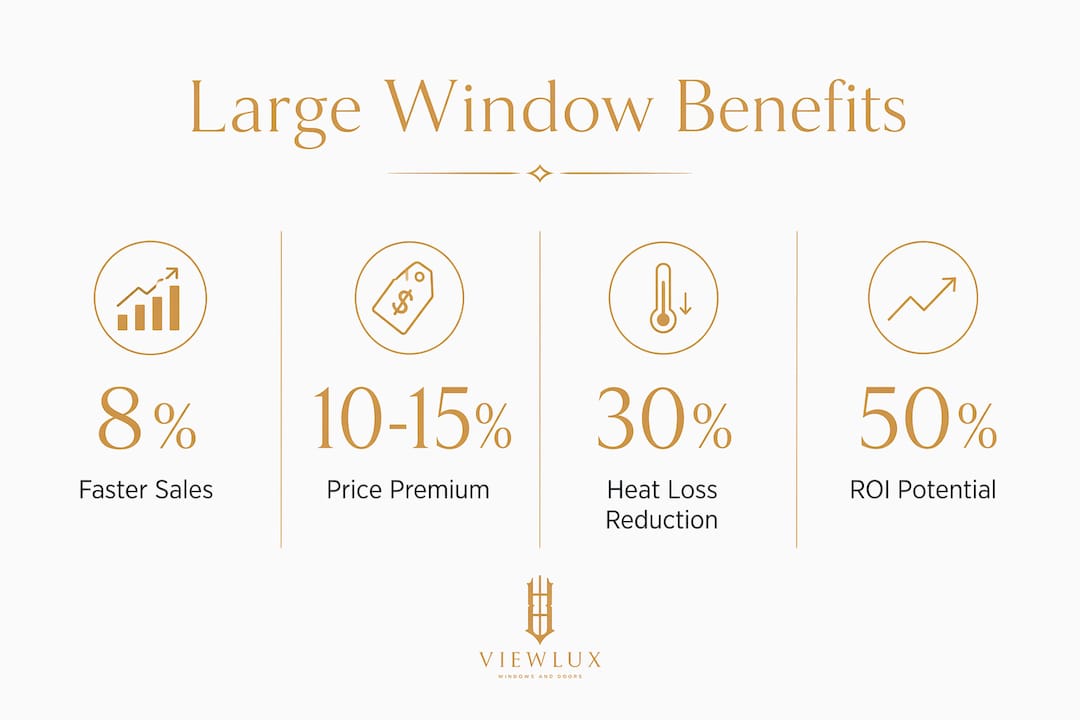
- Speed of sale: Homes with updated windows sell faster — about 8% faster in some datasets — and every week off market reduces mortgage, tax, and maintenance carrying costs.
Table of Contents
- How large windows change buyer perception and market value
- How much value do large or new windows actually add?
- What does a window upgrade actually cost for a typical home?
- Which window projects deliver the best return — and which don’t
- Design and performance risks when adding large windows
- How appraisers and buyers actually account for windows in valuation
- A practical pre-sale checklist for large-window upgrades
- Why NFRC and AAMA certifications matter for resale
- How energy-efficient glazing affects buyer willingness to pay
- Key Takeaways
- The window upgrade decision most homeowners get backwards
- Viewluxwindows: custom aluminum windows, factory-direct pricing
- Key sources and further reading
How large windows change buyer perception and market value
Large windows function as architectural focal points. They increase perceived square footage, connect interior spaces to outdoor views, and flood rooms with natural light — all factors buyers interpret as move-in ready and modern. That perception has measurable market consequences.
Listings that use “bright,” “sun-filled,” or “light-filled” language are associated with a 2–5% price premium in some market comparisons, and homes sell 8% faster in select datasets. Those figures don’t represent the window cost recouped — they represent the buyer’s willingness to pay above comparable listings.
Where large windows create the biggest buyer impact:
- South-facing living rooms in northern markets, where winter light is scarce and buyers actively seek it
- Open-plan kitchens with garden or yard views, where glass connects cooking and dining to outdoor space
- Primary bedrooms with private landscaped views, where the window becomes a selling feature in listing photos
- Entry foyers and stairwells, where tall glass creates an immediate first impression
Orientation matters significantly. South-facing large windows in northern metros generate the strongest price premium — estimated at 3–5% in some design and market guidance. West-facing glass, by contrast, tends to produce late-afternoon heat and glare that buyers notice during afternoon showings, which can work against the premium.
Speed of sale is often the most underestimated component of window ROI. Homes with updated windows sell about 8% faster, which can translate into reduced mortgage, property tax, and utility costs — savings that never appear in the appraisal but absolutely affect net proceeds.
How much value do large or new windows actually add?
Realistic ROI for window projects sits in a range most homeowners find sobering at first glance — and clarifying once they understand the full picture.
Window replacement recoups a moderate portion of project cost at resale according to Cost vs. Value data. Structural enlargements — cutting into walls, adding headers, expanding rough openings — return less on a percentage basis because the labor and structural costs are high relative to the appraised value added. The premium window ROI discussion is more nuanced than a single percentage suggests.
| Scenario | Estimated Project Cost | Typical Recoup % | Estimated Value Added |
|---|---|---|---|
| Replace 10 failing windows (vinyl) | $8,000–$12,000 | 67–69% | $6,000–$12,000 |
| Upgrade to high-performance aluminum (10 windows) | $15,000–$30,000 | — | — |
| Structural enlargement (2–3 windows) | $10,000–$20,000 | — | — |
Ranges are illustrative estimates based on industry cost-vs-value summaries. Actual results vary by market, condition, and buyer pool.
Appraisers and buyers value windows differently. Appraisers work from comparable sales — they rarely add a line-item bonus for new windows unless the market comps support it. What new windows more reliably do is remove a condition deduction. A home with fogged glass, drafts, or rattling frames gives buyers and their agents negotiation leverage; eliminating those inspection objections often produces a better net outcome than the raw appraisal number implies.
Pro Tip: When replacing failing windows before a sale, calculate the “objection removal” value separately from the appraisal math. A buyer who would have asked for a $10,000 price reduction due to window condition is worth $10,000 in net proceeds — even if the appraiser adds nothing.
What does a window upgrade actually cost for a typical home?
For a 2,000 sq ft house with 15–20 windows, total installed costs vary widely by material, glazing spec, and whether structural work is involved.
Per-window installed cost ranges by material:
- Vinyl: $300–$700 per window — highest ROI percentage, lower absolute value in luxury markets
- Fiberglass: $500–$1,200 per window — strong thermal performance, mid-range cost
- Wood: $800–$1,500 per window — premium aesthetic, higher maintenance, strong in traditional markets
- Custom aluminum: $900–$2,500+ per window — preferred in modern and contemporary homes, longest lifespan, NFRC/AAMA-certifiable
Primary cost drivers:
- Structural changes (cutting into load-bearing walls, header installation, framing)
- Glazing specification: double-pane vs. triple-pane, Low-E coatings, argon or krypton fills
- Frame material and finish (powder coat, anodized, wood veneer)
- Custom sizing vs. standard rough openings
- Installation complexity: multi-story, difficult access, flashing and weatherproofing requirements
- Permit fees, which vary by municipality and project scope
Three budget scenarios for a pre-sale project:
- Minimal replacement (swap like-for-like, vinyl, standard sizes): $6,000–$12,000 for a whole home
- Performance upgrade (high-performance double-pane, Low-E, aluminum frames, no structural work): $15,000–$30,000
- Structural enlargement (2–4 windows enlarged, custom glazing, permits, header work): $20,000–$50,000+
Enlarging windows is often a structural job. Cutting into load-bearing walls requires headers, framing changes, and sometimes electrical or insulation rework — hidden costs that can exceed the glass price itself.
Which window projects deliver the best return — and which don’t
Not all window spending produces equal results before a sale. Prioritizing correctly is where most homeowners leave money on the table.
High return:
- Replacing failed or single-pane windows — removes inspection objections and signals move-in readiness
- Energy-efficient upgrades (Low-E double-pane) in climate-sensitive markets — verifiable utility savings attract buyers
- Strategic large windows in main living spaces with favorable orientation — south-facing living rooms and kitchen-to-yard glass in northern markets
Moderate return:
- Premium aluminum frames in contemporary or upscale markets — aluminum suits modern remodels and holds its finish without painting
- Selective picture windows where they improve a genuine view — a landscaped backyard or mountain sightline adds real value; a fence or neighboring wall does not
Low return:
- Triple-pane in mild climates purely for resale — the cost premium rarely comes back in markets where double-pane Low-E already satisfies buyers
- Purely decorative large glass in non-strategic locations (north-facing utility rooms, seldom-used guest bedrooms)
- Oversized glass facing a noisy street or adjacent structure — privacy and shading costs can reduce buyer appeal rather than increase it
Pro Tip: Fix every inspection red flag first. A buyer who sees fogged glass or a broken seal will question what else was deferred. Use remaining budget for value-driving placements in living rooms and kitchens.
Design and performance risks when adding large windows
Large windows carry real trade-offs that affect both buyer experience and project cost. Understanding them before contracting avoids expensive corrections.
Thermal and comfort risks:
- Solar heat gain: Large unshaded south- or west-facing glass can overheat interior spaces. Balancing daylight with thermal control requires Low-E coatings, exterior shading, or both — adding glass area without addressing this can undermine buyer comfort during showings.
- Glare: Floor-to-ceiling glass without shading produces glare that makes rooms feel uncomfortable. Buyers notice this during daytime showings.
- Condensation: Improperly specified glazing in cold climates can produce interior condensation, which buyers and inspectors flag as a moisture concern.
Privacy and design risks:
- Large street-facing glass reduces privacy and can feel exposed, particularly in dense neighborhoods.
- Glass that doesn’t match the home’s architectural style reads as an afterthought rather than a feature.
- Mismatch between window scale and ceiling height can make rooms feel awkward rather than spacious.
Structural and permitting risks:
- Cutting into load-bearing walls without proper engineering can create structural liability.
- Many municipalities require permits for window enlargements; unpermitted work creates title and disclosure issues at closing.
- Flashing failures around large openings are a leading cause of water intrusion — a serious inspection flag.
Mitigation actions:
- Specify Low-E coatings matched to your climate zone (solar control Low-E for hot climates, passive Low-E for cold)
- Plan exterior overhangs or interior shading for west- and south-facing glass
- Pull permits for all structural work and retain documentation for the listing packet
- Use a licensed structural engineer for any load-bearing wall modification
How appraisers and buyers actually account for windows in valuation
Appraisers and buyers approach windows from fundamentally different angles — and sellers who understand both can present their upgrade more effectively.
Appraisers work from comparable sales data. They assess condition and note deficiencies, but they rarely add a specific dollar line for new windows unless the local comp set supports it. The practical effect: new windows more often remove a negative adjustment than create a positive one. A home with failed windows may be adjusted down; a home with new windows returns to baseline condition.
Buyers operate on perception. Natural light, clean frames, and the absence of inspection issues create subconscious confidence. That confidence reduces the likelihood of low offers, inspection-based renegotiations, and buyer walkouts — all of which affect net proceeds even when the appraised value stays flat.
Listing language that works:
- “Sun-filled living room with floor-to-ceiling south-facing glass”
- “Newly installed energy-efficient windows throughout — NFRC certified”
- “Bright open-plan kitchen with garden views”
Document checklist for the listing packet:
- NFRC label scans for each window product installed
- AAMA certification documentation from the manufacturer
- Energy-savings estimates (utility cost comparison, if available)
- Installation warranty and contractor license number
- Permit documentation for any structural work
- Product spec sheets showing U-factor and SHGC ratings
Including this documentation in the listing packet gives buyers and their agents verifiable proof of quality — and gives appraisers supporting documentation they can reference when noting condition.
A practical pre-sale checklist for large-window upgrades
Following a structured sequence prevents the most common and costly mistakes homeowners make when upgrading windows before listing.
Contractor selection and scoping:
- Get three itemized bids — line-item, not lump-sum, so you can compare glazing spec, structural scope, and installation details separately
- Confirm each contractor carries a valid license and general liability insurance
- Ask specifically whether any window location requires structural work (header installation, framing changes)
- Verify that the proposed products carry NFRC labels and AAMA certification
Specification and permitting:
- Confirm glazing spec in writing: U-factor, SHGC, pane count, Low-E coating type, and gas fill
- Pull permits for any structural enlargement before work begins — retain all permit documentation
- Request flashing and weatherproofing details in the scope of work
Timeline and completion:
- Custom aluminum windows typically carry 6–12 week lead times; plan accordingly relative to your listing date
- Schedule a final walkthrough before contractor sign-off to check for condensation, seal integrity, and finish quality
- Collect all warranty documents, NFRC labels, and permit sign-offs before the contractor leaves
Questions to ask every contractor:
- Does this location require a structural engineer’s assessment?
- What flashing system do you use, and is it included in the bid?
- How do you handle condensation risk in this climate zone?
- What is the warranty on both the product and your installation labor?
- Will you provide NFRC label documentation and AAMA certification for the products installed?
The 3-estimate rule matters more for window projects than most homeowners expect. Bids on the same scope can vary by 30–40% depending on glazing spec and whether structural allowances are included.
Why NFRC and AAMA certifications matter for resale
Performance certifications are the most underused marketing tool in a pre-sale window upgrade. Most homeowners install certified products and never mention them in the listing.
U-factor measures how much heat a window loses — lower is better. A U-factor of 0.30 or below meets ENERGY STAR criteria for most U.S. climate zones. Buyers in cold markets respond to low U-factor figures because they translate directly to heating cost savings.
SHGC (Solar Heat Gain Coefficient) measures how much solar heat passes through the glass. Lower SHGC values (0.25 or below) are preferred in hot climates to reduce cooling loads; higher values (0.40+) are preferred in cold climates to capture passive solar heat. Matching SHGC to climate zone is one of the most consequential glazing decisions a homeowner can make.
NFRC labels provide independently verified U-factor and SHGC ratings for each product. They function as a trust signal for buyers who want proof that the windows perform as claimed. Scanning and including NFRC labels in the listing packet takes five minutes and can convert an energy-conscious buyer who would otherwise hesitate.
AAMA certification (from the American Architectural Manufacturers Association) verifies that a window product meets structural, water resistance, and air infiltration standards. It tells buyers and inspectors that the product was manufactured to a documented quality standard.
Pro Tip: Request NFRC label scans and AAMA certification documentation from your contractor before installation is complete — it’s far easier to get them during the project than after.
Trust-signal checklist for the listing packet:
- NFRC label (U-factor and SHGC for each product)
- AAMA certification number and product category
- Product warranty (manufacturer)
- Installation warranty (contractor)
- Installer license and insurance documentation
How energy-efficient glazing affects buyer willingness to pay
Energy performance is increasingly a purchase criterion, not just a nice-to-have. Buyers in markets with high utility costs — California, the Southwest, the upper Midwest — actively ask about window ratings during showings and inspections.
Low-E coatings, double-pane construction, and argon fills work together to reduce heat transfer, block UV degradation of interior finishes, and lower both heating and cooling loads. For a buyer comparing two otherwise similar homes, the one with documented energy-efficient windows presents a lower cost of ownership — and buyers increasingly price that difference into their offers.
Triple-pane glazing offers meaningful benefits in cold or high-noise markets, but its cost premium over double-pane Low-E rarely comes back in mild climates. The practical guidance: specify double-pane Low-E as the baseline for any pre-sale upgrade, and consider triple-pane only in northern markets where heating costs are a dominant buyer concern.
The U.S. Department of Energy notes that heat gain and heat loss through windows account for 25–30% of residential heating and cooling energy use. That figure gives sellers a concrete talking point: new, properly specified windows reduce the home’s largest variable operating cost. Framing the upgrade in those terms — rather than just “new windows” — positions it as a financial benefit, not a cosmetic one.
Key Takeaways
Large windows increase sale price most reliably when they are well-placed, properly specified with NFRC/AAMA-rated glazing, and installed in main living spaces — with speed of sale often delivering as much financial return as the appraised value increase.
| Point | Details |
|---|---|
| Fix failing windows first | Removing inspection objections often produces better net proceeds than cosmetic enlargements. |
| Expect 67–69% cost recoup | Window replacement returns roughly a moderate portion of project cost at resale per Cost vs. Value data. |
| Placement drives premium | South-facing living-room glass in northern markets generates the strongest buyer price response. |
| Speed of sale is real ROI | Homes with updated windows sell about 8% faster; reduced carrying costs add to total project return. |
| Viewluxwindows for certified performance | Viewluxwindows offers NFRC/AAMA-certified custom aluminum windows factory-direct, reducing cost while providing the documentation buyers and appraisers need. |
The window upgrade decision most homeowners get backwards
Most sellers approach window upgrades as a cosmetic decision. They ask “Will this look better?” when the more useful question is “What is this buyer’s biggest objection, and does this upgrade remove it?”
The data consistently shows that the financial return from window upgrades comes from two places: removing friction (inspection issues, energy concerns, perceived deferred maintenance) and capturing the speed-of-sale benefit. The buyer who walks through a home with clean, certified, well-placed windows doesn’t consciously calculate a premium — they simply feel more confident making a full-price offer with fewer contingencies.
What gets underestimated is the orientation and placement discipline. A large window facing a blank wall or a busy street can actually reduce buyer appeal by creating privacy concerns or noise exposure. The same budget spent on a south-facing picture window in the living room, with proper Low-E glazing and documented NFRC ratings, produces a fundamentally different buyer response. The glass area matters less than where it goes and how it performs.
For sellers with limited budgets, the sequence is clear: fix the inspection red flags first, then allocate remaining funds to one or two high-impact placements in the main living space. That approach consistently outperforms spending the same money on uniform upgrades across every room.
Viewluxwindows: custom aluminum windows, factory-direct pricing
Homeowners who want the full resale benefit of large, high-performance windows without the traditional dealer markup have a direct alternative. Viewluxwindows manufactures and sells custom aluminum windows and doors factory-direct, with savings of up to 50% compared to conventional dealer pricing — a difference that meaningfully changes the ROI math on a pre-sale upgrade.

Every Viewluxwindows product carries NFRC and AAMA certifications, giving sellers the documentation buyers and appraisers need. The 26-step production process covers glazing specification, thermal performance, and finish quality — and the team can provide NFRC label scans, product warranties, and installation documentation for your listing packet. Showrooms are open across California, Colorado, and Nevada for homeowners who want to see the product before specifying.
Browse the upscale residential window packages for design examples and specifications, or review the energy-efficient glazing options to match the right glazing spec to your climate zone and listing timeline. Request an estimate directly through the website to get a factory-direct price on your project.
Key sources and further reading
Sellers, agents, and contractors who want to document window performance for a listing packet or verify the claims in this article will find the following sources useful.
- ENERGY STAR — Residential Windows, Doors & Skylights: The primary U.S. government source for energy performance criteria by climate zone; use this to verify whether a proposed product qualifies and to include certification language in the listing.
- U.S. Department of Energy — Update or Replace Windows: Plain-language guidance on when to repair vs. replace and how windows affect heating and cooling costs; useful background for the energy-savings talking points in a listing.
- MDPI Buildings — Impact of Building Windows on Occupant Well-Being: Peer-reviewed review of daylight, glare, thermal, and circadian effects of window design; supports the glazing specification and orientation guidance in this article.
- IOPscience — Reassessing the Value of Window Views: Academic review of price premiums associated with window views across urban markets; useful for agents citing view-related value in listing documentation.
- GetWindowCost — Replacement Window ROI Data: Industry summary of Cost vs. Value recoup percentages and speed-of-sale data; the source for the 67–69% recoup figures cited in this article.
- Will It Be Bright — Natural Light and Home Value: Market data on listing language, price premiums, and speed-of-sale effects tied to natural light; source for the 2–5% premium and 8% faster-sale figures.
- Opendoor — Do New Windows Increase Home Value?: Real estate platform guidance on inspection objections, glazing selection, and when triple-pane is justified; practical framing for the buyer-perception vs. appraisal distinction.
- Viewluxwindows — Upscale Residential Window Packages: Portfolio of certified custom aluminum window packages with design examples; include the URL in your listing packet to give buyers a reference for the product specification.
- Viewluxwindows — Aluminum Windows ROI for Homeowners: Brand-specific ROI discussion covering NFRC/AAMA certifications and factory-direct cost advantages; useful for homeowners comparing material options before a pre-sale upgrade.
This article provides general informational guidance on window upgrades and resale value. It is not a substitute for professional appraisal, legal, or financial advice. Confirm current market conditions, permit requirements, and product specifications with a licensed contractor, appraiser, or real estate professional for your specific situation.
Recommended
- Do Premium Windows Increase Property Value? – ViewLux Windows And Doors, Inc.
- Custom vs Standard Windows: Real Cost Differences in 2026 – ViewLux Windows And Doors, Inc.
- Aluminum Windows ROI Explained for Homeowners in 2026 – ViewLux Windows And Doors, Inc.
- Factory Direct Window Pricing Benefits for Homeowners – ViewLux Windows And Doors, Inc.


